About Spiranthes romanzoffiana Cham.
Nomenclature and Growth Form
Hooded lady's tresses, whose scientific name is Spiranthes romanzoffiana Cham., is a perennial orchid with a fleshy rootstock.
Vegetative and Inflorescence Structure
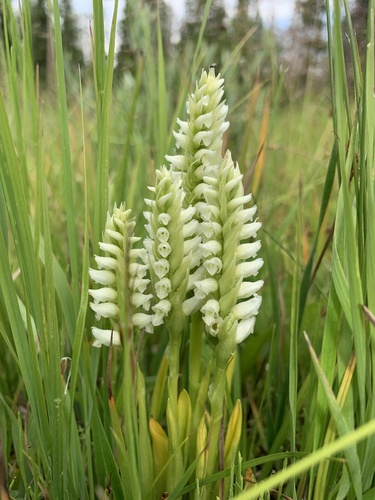
It produces shoots with lanceolate leaves, and its flowers grow in three spirally twisted rows.
Flower Morphology
Each scented flower has united sepals and petals that form the lip of a tube; the labellum, or lower petal, is white with green veins.
Bloom Period
This plant blooms in late summer.
Sexual Reproduction
Its flowers are pollinated by insects, and it produces tiny, dust-like seeds that are dispersed by wind.
Vegetative Reproduction
It can also reproduce vegetatively via root tubers, which grow new shoots as the old parts of the plant die.
Mycorrhizal Association
This orchid forms an association with a mycorrhizal fungus that supplies it with essential nutrients.
Formal Description Origin
It was first formally described by German botanist Adelbert von Chamisso, who named it to honor his patron Nikolay Rumyantsev.
Collection Background
Rumyantsev financed the 1815–1818 scientific exploration of the Americas where Chamisso collected this orchid.
Broad Geographic Range
It is common across North America, including Canada and the United States, and also grows in a small number of locations in Scotland and Ireland.
British Isles Conservation Status
It is currently considered regionally extinct in England, but was rediscovered in Wales in 2019.
Irish First Record
The first recorded observation of this species in Ireland was made in 1810 in County Cork.
Irish Distribution Sites
Since that time, it has been found in multiple other locations across Ireland and Northern Ireland, including the Lough Neagh basin, the Mourne Mountains, and the hills of Antrim.
Habitat Preferences
It grows along lakeshores and in damp pastures.
Distribution Phenomenon
Its distribution pattern, occurring on both sides of the Atlantic Ocean, remains unexplained and puzzling.
West Irish Pollinator Studies
Studies of pollinator interactions for this species have only been carried out on West Irish populations; the most common pollinators recorded there are Bombus pascuorum, B. hortorum, and Apis mellifera.
Irish Mycorrhizal Research Gap
No studies have yet been done on the mycorrhizal associations of Irish populations of this orchid.
Canadian Hybrid Findings
Recent research has identified genetic hybrids in the Ontario, Canada population of this species.
European Population Genetic Studies
Genetic studies have also been completed to assess the genetic diversity of the European population.