About Acianthus pusillus D.L.Jones
Plant Growth Form
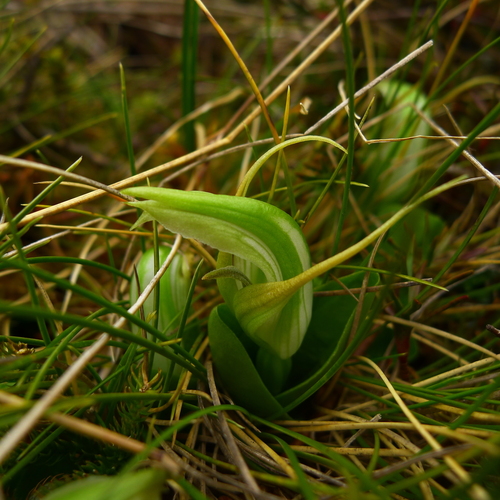
Acianthus pusillus is a terrestrial, perennial, deciduous, sympodial herb that grows from a single heart-shaped, hairless, dark green leaf with a reddish-purple lower surface.
Leaf Characteristics
The leaf itself measures 12–32 mm long and 10–30 mm wide, and is carried on a stalk 30–80 mm tall.
Inflorescence Traits
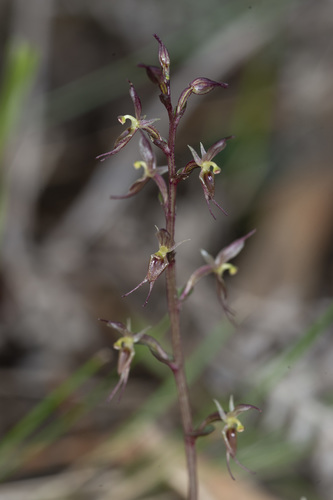
Up to 18 translucent green to pinkish flowers with reddish veins and spots are arranged on a thin raceme 30–180 mm tall; each flower extends out from the raceme and is 8–12 mm long.
Dorsal Sepal Morphology
The dorsal sepal is linear to egg-shaped, 6–8.5 mm long, and 2.5 mm wide, ending in a pointed tip 1–2.5 mm long that forms a hood covering the column.
Lateral Sepal Morphology
The lateral sepals are 6–8 mm long, about 1 mm wide, linear to narrow lance-shaped, with a 1–2.5 mm long tip, and project forwards at oblique angles, running parallel to each other or crossing.
Petal Morphology
The petals are translucent with a central red stripe, 2.5–3 mm long, about 1 mm wide, linear to egg-shaped, and point backwards toward the ovary.
Labellum Shape
The labellum is 4.0–4.5 mm long and 2–3 mm wide, heart-shaped to elliptic when flattened, slightly curved into a dish shape near the base with rolled-under edges, and lacks teeth.
Labellum Callus
A thick, fleshy callus covers most of the upper surface of the labellum, and the outer half of the callus sometimes has many small pimple-like papillae.
Flowering Period
Flowering occurs from March to August.
Fruit Characteristics
After flowering, it produces an oval-shaped capsule 7–8 mm long and about 2 mm wide.
Similar Species Distinction
This species can be told apart from the similar Acianthus exsertus by its generally smaller leaf, smaller flowers, and much smaller labellum.
General Habitat Range
This orchid is widespread and locally common across a range of habitats, from rainforest margins to heathland on inland hills.
Queensland Distribution
In Queensland, it is found in the Port Curtis and Moreton botanical districts.
New South Wales Distribution
In New South Wales, it occurs on the North Coast, Central Coast, South Coast, Northern Tablelands, Central Tablelands, and Southern Tablelands.
Southern Australia Distribution
It grows in southern parts of Victoria, in the Flinders Ranges, Eyre Peninsula, Northern Mount Lofty, Southern Mount Lofty, Murray, Yorke Peninsula, Kangaroo Island, and South-Eastern Botanical Regions of South Australia, and throughout Tasmania.
Colony Formation
It sometimes forms colonies containing thousands of individual plants, with leaves often forming a dense carpet over the ground.