About Sphagnum rubellum Wilson
Taxonomic Naming
Sphagnum rubellum Wilson, the red dwarf bog-moss, was originally formally described by English bryologist William Wilson in 1855. Wilson gave it the common name red dwarf bog-moss in reference to its slender stems and small, reddish appearance.
Original Description Reproductive Trait
In his original description, he recorded that the species is dioicous, meaning it produces male and female reproductive structures on separate individual plants.
Original Morphology Observations
He characterised its leaves as elliptical, obtuse, and subsucculent, and noted the species has short, deflexed, attenuated branches. Its spore-containing capsules were described as subexserted, meaning they barely protrude from their protective covering, the perichaetium.
Original Habitat Records
Wilson observed S. rubellum growing among other peat mosses, specifically noting its presence at Risley Moss near Warrington, where it most often occurred in moderately moist areas growing alongside Sphagnum molluscum.
Original Species Distinction From S. molluscum
Wilson distinguished S. rubellum from other Sphagnum species using morphological traits: compared to S. molluscum, S. rubellum has slightly smaller stems and fewer branches. He also described the species’ stem leaves as round-ovate, slightly concave, with a transparent (pellucid) margin, while its branch leaves are elliptic-obtuse and ovate.
Original Distinction From S. acutifolium
Though it bears some resemblance to S. acutifolium (now generally considered part of a broader species complex), Wilson distinguished S. rubellum by its smaller size, neat appearance, and distinctive leaf shape.
General Size
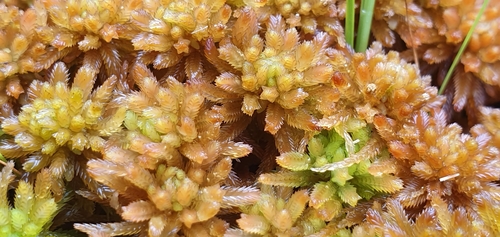
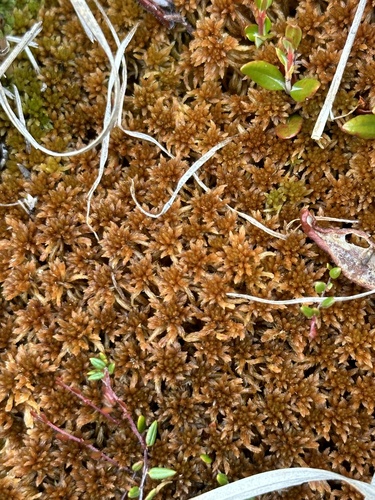
Sphagnum rubellum is a small peat moss that typically measures less than 1 cm in diameter.
Coloration
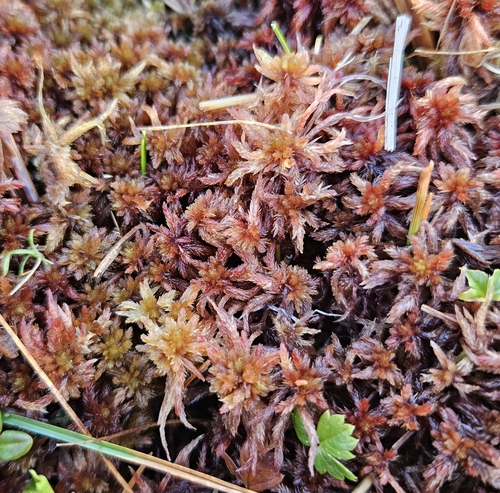
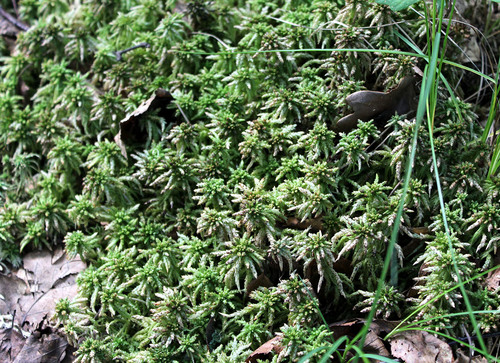
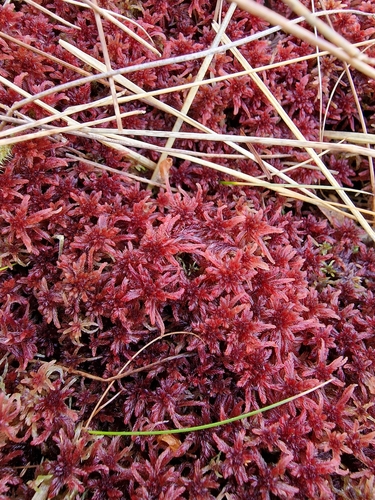
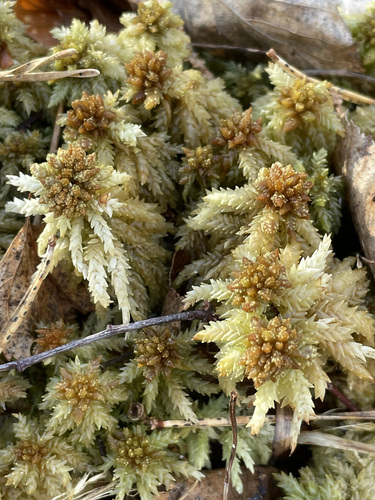
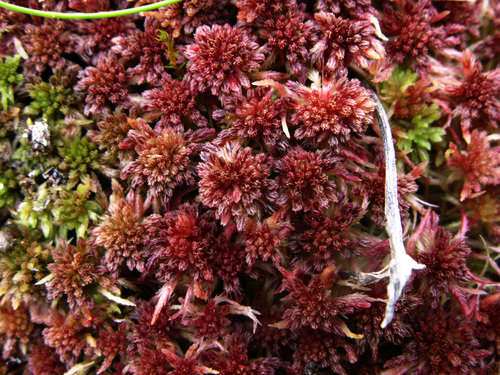
Its colour is variable, ranging from green through pink to deep crimson, and it may occasionally appear copper-coloured.
Capitulum Trait
It can be identified by its distinctive growing tip (called a capitulum), where the apical bud is visible and sits slightly elevated above the surrounding inner branches.
Stem Leaf Diagnostic Feature
A key diagnostic feature is its 1.0–1.25 mm long, tongue-shaped (lingulate) stem leaves.
Similarity To S. capillifolium
It is frequently confused with its close relative S. capillifolium, but several features can be used to tell the two species apart. When they grow together, S. rubellum usually appears lighter red than S. capillifolium.
Distinguishing Traits From S. capillifolium
The most reliable distinguishing traits are in the stem leaves and growing tips: S. rubellum has tongue-shaped stem leaves and a visible apical bud, while S. capillifolium has oblong stem leaves that gradually taper to a point, and its apical bud is usually hidden from view. These features can easily be observed with a hand lens in the field.
Subgenus Placement
Sphagnum rubellum belongs to the subgenus Acutifolia, a group that contains small to medium-sized slender Sphagnum plants with narrow, elongated branches.
Growth Form And Colour
S. rubellum plants have a loose growth form with flat capitula (growing tips), and match the species-wide colour range of green to pink or deep crimson.
Fascicle Traits
Its branch clusters, called fascicles, are usually spaced apart rather than densely packed, which lets the stem be visible between the clusters.
Stem Leaf Morphology
Its stem leaves are tongue-shaped (lingulate), 1.0–1.25 mm long, weakly fibrillose or sometimes almost lacking fibrils, with numerous cross-walls called septa.
Branch Leaf Morphology
Its branch leaves are loosely arranged in five distinct rows, appear rather blunt, have concave tips and slightly curved edges.
Spore Morphology
Reproductive spores of S. rubellum have three radiating ridges forming a Y-shaped pattern, called trilete spores. Compared to related species in section Acutifolia, these spores are relatively large, ranging from 19.4–33.3 micrometres (μm) in diameter with a mean diameter of 26.1 μm.
Spore Surface Traits
Both spore surfaces have uneven deposits of protective coating material. This distinct spore morphology helps distinguish S. rubellum from closely related species such as S. nemoreum.
Global Distribution
Sphagnum rubellum has a circumboreal distribution, found across cool temperate regions of North America and Eurasia in a belt-like pattern around the Northern Hemisphere.
Climate Preference
The species has a distinct preference for oceanic conditions, which shapes both its distribution and its habitat preferences; it occurs from sea level up to elevations of 2,200 m (7,200 ft). This preference for oceanic conditions sets it apart from its close relative S. capillifolium, which tolerates more continental climates and has a broader overall distribution.
Habitat Type
Sphagnum rubellum grows predominantly in open peatlands called mires, in conditions ranging from ombrotrophic (receiving all water and nutrients from precipitation) to weakly minerotrophic (receiving some nutrients from groundwater). In these habitats, it forms extensive carpets, and occasionally develops into low hummocks.
Habitat Contrast With S. capillifolium
This habitat preference differs from that of S. capillifolium, which favours minerotrophic conditions, and typically forms compact hummocks on relatively dry ground in shaded forests and open subarctic heaths.
Microhabitat Within Bogs
Within bog systems, S. rubellum is most often found on exposed, rather wet mire expanses, and avoids the drier, shaded mire margins preferred by S. capillifolium. This habitat differentiation is particularly pronounced in continental regions.
Co-occurrence With S. capillifolium
In areas where both species grow together, such as mire margins, S. capillifolium tends to be the more abundant of the two.
Ecological Habitat Range
Ecologically, Sphagnum rubellum grows in bogs and poor fens (wetlands with some groundwater input), occurring in habitats ranging from raised hummocks to flat lawns. It typically grows in distinctly acidic locations that sit somewhat raised above the water table.
Growth Form In Habitats
The species is strictly ombrotrophic and typically forms large, uniform lawns and carpets on treeless bogs.