About Speothos venaticus (Lund, 1842)
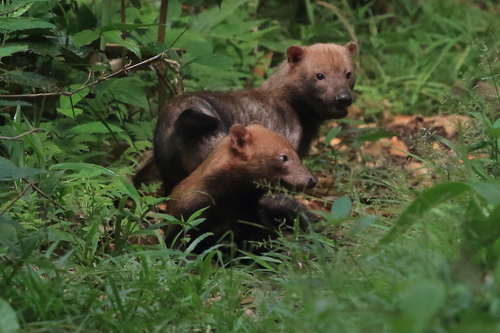
Description: Adult bush dogs have soft, long brownish-tan fur, with a lighter reddish tinge on the head, neck, and back, plus a bushy tail. The underside is dark, and sometimes features a lighter throat patch. Younger individuals, by contrast, have solid black fur across their entire bodies. Adults typically measure 57–75 cm (22–30 in) from head to body, with a tail that is 12.5–15 cm (5–6 in) long. They stand 20–30 cm (8–12 in) tall at the shoulder, and weigh between 5–8 kg (11–18 lb). They have short legs relative to their body size, as well as a short snout and relatively small ears. Their teeth are specialized for their carnivorous diet. Uniquely among American canids, their dental formula is 3.1.4.1 / 3.1.4.2, giving them a total of 38 teeth. The bush dog is one of only three canid species (alongside the dhole and the African wild dog) that have trenchant heel dentition: this means the talonid of the lower carnassial tooth has a single cusp that extends the length of the tooth's cutting blade. Females have four pairs of teats, and both sexes have large scent glands on either side of the anus. Bush dogs have partially webbed toes, which lets them swim far more efficiently. Distribution and habitat: Bush dogs range from Costa Rica in Central America, through most of South America east of the Andes, as far south as central Bolivia, Paraguay, and southern Brazil. They primarily live in lowland forests up to 1,900 metres (6,200 ft) in elevation, wet savannas, and other habitats located near rivers, though they may also occur in drier cerrado and open pasture. The species' historic range may have extended as far north as Costa Rica, where bush dogs may still persist in suitable habitat. New repeated observations of bush dog groups have been documented in east-central Costa Rica's Barbilla National Park, south-eastern Costa Rica's La Amistad International Park, and across a large portion of the Talamanca Mountains up to 120 km (75 mi) north-northwest, at elevations as high as 2,119 m (6,952 ft). Very recent fossils dated between 300 AD and 900 AD, from the Late Ceramic Age, have been discovered at the Manzanilla site on Trinidad's eastern coast. Three subspecies of bush dog are currently recognized. The South American bush dog (Speothos venaticus venaticus) ranges across southern Colombia and Venezuela, the Guyanas, most of Brazil, eastern Ecuador and Peru, Bolivia, and northern Paraguay. The Panamanian bush dog (Speothos venaticus panamensis) occurs across Panama, northern Colombia and Venezuela, and western Ecuador. The southern bush dog (Speothos venaticus wingei) is found in southern Brazil and Paraguay, as well as extreme northeastern Argentina. The first camera trap photos of the species in Argentina were taken in April 2016 at the Selva Paranaense Don Otto Ecological Private Reserve, located in Eldorado Department, Misiones Province, Argentina. Reproduction: Bush dogs mate year-round; oestrus lasts up to twelve days and occurs every 15 to 44 days. Like many other canids, bush dog mating includes a copulatory tie, during which the two individuals remain locked together. Urine marking plays an important role in the species' pre-copulatory behavior. Gestation lasts between 65 and 83 days, and typically produces a litter of three to six pups, though litters as large as 10 have been recorded. Pups are born blind and helpless, and weigh 125 to 190 grams (4.4 to 6.7 oz) at birth. Their eyes open 14 to 19 days after birth, and pups begin emerging from their birth den shortly after that. Pups are weaned at around four weeks old, reach sexual maturity at one year of age, and can live up to 10 years in captivity.