About Spea intermontana (Cope, 1883)
Identification Note
For identification: The Great Basin spadefoot, Spea intermontana, measures 3.8 to 6.3 centimetres (1.5 to 2.5 inches) in length.
Base Coloration
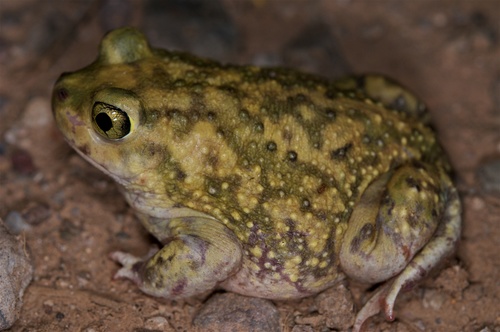
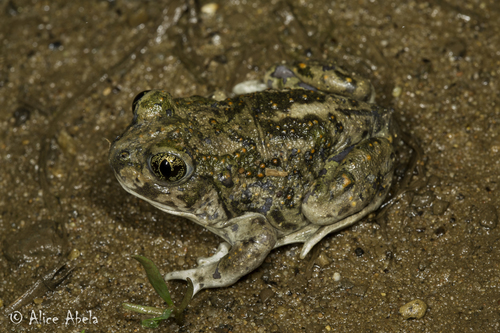
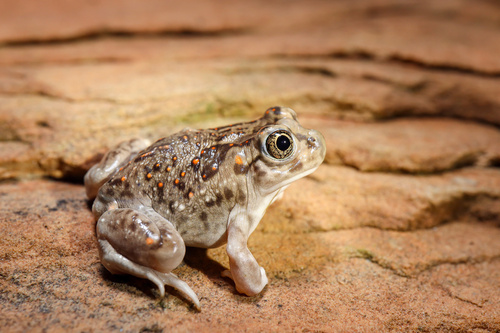
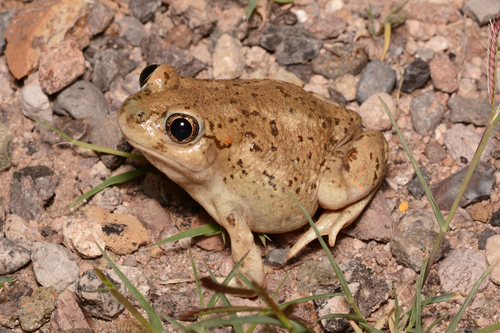
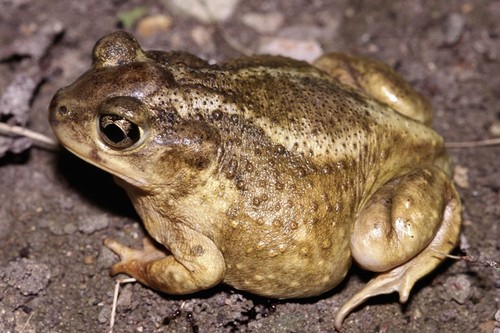
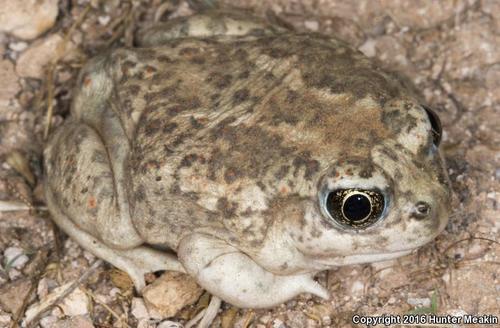
Its base color is most commonly gray, olive, or brown. Gray streaks form an outline around an hourglass-shaped marking on the animal's back.
Skin Texture
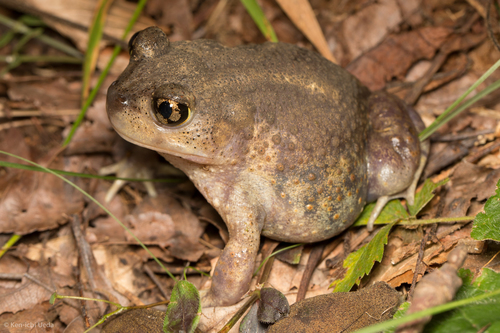
Compared to the bumpy skin of true toads in the genus Bufo, the Great Basin spadefoot has smooth skin.
Hind Foot Spade
Each hind foot has a wedge-shaped, sharp-edged spade on its inner side.
Interocular Gland
A raised glandular area, called a boss, sits between the spadefoot's eyes.
Eye Characteristics
Its eyes are catlike, with vertical pupils in bright light and round pupils at night. Each upper eyelid has dark brown spots.
Natural Habitats
For habitat and distribution: The natural habitats of the Great Basin spadefoot include pinyon-juniper woodland, ponderosa pine forest, and high elevation (up to 2,600 metres or 8,500 feet) spruce-fir forest, alongside semidesert shrubland, sagebrush flats, temperate grasslands, and deserts. The species is also found in agricultural areas.
Northern Range Extent
Its range extends from southern British Columbia through eastern Washington and eastern Oregon, and into southern Idaho.
Southern and Eastern Range
It occurs across all of Nevada and most of Utah, with small populations also present in parts of California, Arizona, Colorado, and Wyoming.