About Spathoglottis plicata Blume
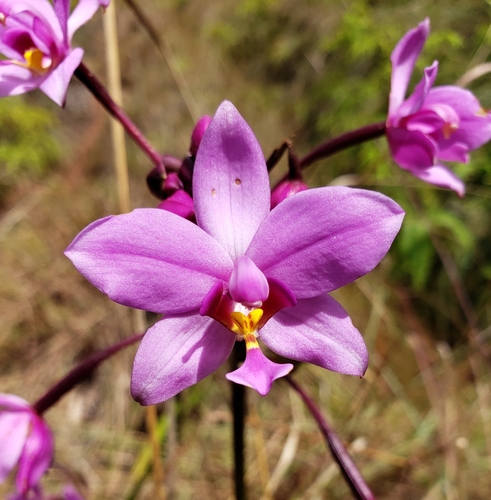
Spathoglottis plicata Blume is an evergreen, terrestrial herb that grows in tall clumps. It produces crowded pseudobulbs that measure 40–60 mm (1.6–2.4 in) long and 20–40 mm (0.8–2 in) wide. Each pseudobulb bears three or four pleated leaves 50–90 cm (20–35 in) long and 8–15 mm (0.3–0.6 in) wide, carried on a stalk 80–150 mm (3–6 in) long. Up to forty resupinate flowers, colored deep pink to purple, are borne on a hairy flowering stem 50–100 cm (20–40 in) tall; each flower is 35–55 mm (1–2 in) long and wide. The dorsal sepal is 20–30 mm (0.8–1 in) long, and the lateral sepals are slightly narrower. Petals are roughly the same length as the sepals but significantly wider. The labellum is T-shaped, about the same size as the dorsal sepal, and has three lobes with the side lobes oriented close to vertical. At the tip of the column there is a cap, under which masses of yellow pollen grains can be seen. Flowering occurs from September to April in Australia, and in most months in China and New Guinea. The fruit is a green, cylindrical capsule around 3 mm (0.1 in) long. After the flower is fertilized, seeds take about six weeks to develop. When ripe, the capsule splits open and thousands of tiny seeds are dispersed by wind. This species, commonly known as the large purple orchid, is distributed across Taiwan, southern India, Indonesia, Japan, Malaysia, New Guinea, the Philippines, Sri Lanka, Thailand, Vietnam, Myanmar, Australia, Tonga and Samoa. In Australia, it occurs from Cooktown to the Jardine River on Cape York Peninsula. It grows in seasonally inundated and other moist areas, in open sunny locations near swamps, seepages, and small streams. Spathoglottis plicata and its varieties have been cultivated and selectively bred. The typical form bears bright purple flowers, while some variants produce mauve or pale mauve flowers. A rare pure white form is named ‘Penang White’. Because it is hardy and grows quickly, Spathoglottis plicata is cultivated and used to hybridize with other mountain Spathoglottis that do not grow well in lowlands, to produce more horticulturally interesting varieties. The first Spathoglottis hybrid was created in 1932 by Richard Eric Holttum, who crossed S. plicata with S. aurea and named the hybrid Spathoglottis 'Primrose'. ‘Dwarf Legion’ is a hybrid between 'Primrose' and S. tomentosa, a dwarf form that produces flowers in a range of colors from pink to yellow, including pure cream. For cultivation, Spathoglottis plicata requires well-drained, well-aerated soil, with the upper part of the pseudobulb planted above ground level. Frequent applications of dilute manure water are recommended for growing this species.