About Caladenia stellata D.L.Jones
Growth Form
Caladenia stellata is a terrestrial, perennial, deciduous herb that grows from an underground tuber.
Leaf Characteristics
It produces a single dull green, hairy, linear leaf that is 60 to 150 millimetres long and 5 to 10 millimetres wide, with reddish-purple blotches near the leaf base.
Flower Stalk
Most often, a single flower around 40 millimetres across is borne on a stalk that is 120 to 300 millimetres tall.
General Flower Coloration
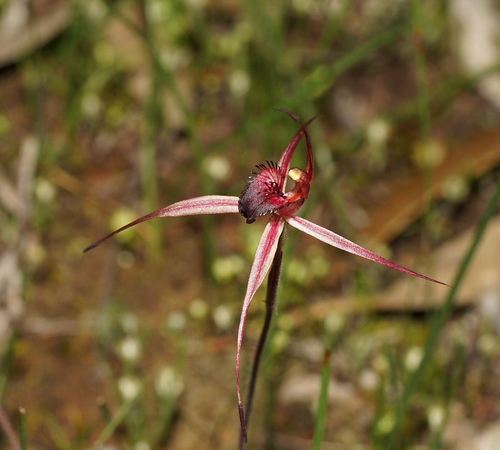
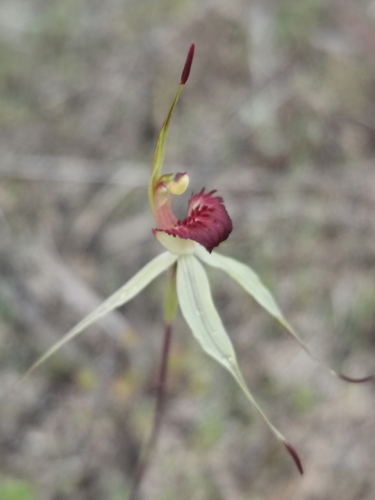
The flowers are greenish cream, and the sepals have thick, dark red, club-shaped glandular tips that are 5 to 10 millimetres long.
Dorsal Sepal Morphology
The dorsal sepal stands erect, is 25 to 40 millimetres long and 1 to 3 millimetres wide, and curves gently forward.
Lateral Sepal Morphology
The lateral sepals are 26 to 40 millimetres long and 2 to 4 millimetres wide, spread widely, and curve slightly downwards.
Petal Morphology
The petals are 20 to 30 millimetres long, around 2 millimetres wide, and curve downwards.
Labellum Basic Features
The labellum is 12 to 18 millimetres long and 7 to 13 millimetres wide, and is greenish-cream with a dark red tip.
Labellum Margin Structure
The sides of the labellum curve upwards, the tip curls under, and there are six to eight short linear teeth along each side.
Labellum Calli
Four rows of dark red, club-shaped calli run along the mid-line of the labellum.
Flowering Period
Flowering takes place from August to October.
Common Name and Distribution
This orchid, commonly called the starry spider orchid, is distributed in New South Wales south of Rankins Springs and in eastern South Australia, where it typically grows in Callitris woodland.
Taxonomic Note
It has been noted that South Australian populations of this plant may belong to a separate species.
Pollination Mechanism
Males of the wasp species Phymatothynnus nitidus act as pollinators for this orchid, pollinating it when they attempt to mate with the flower.