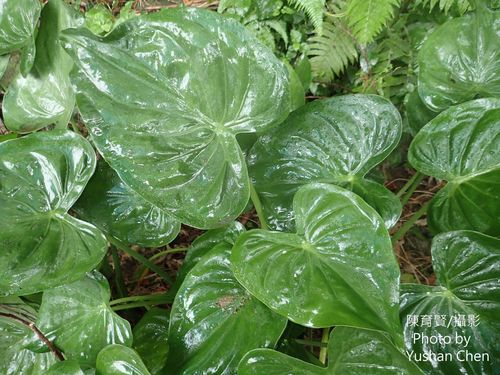
About Spathiphyllum wallisii Regel
Spathiphyllum wallisii Regel is a herbaceous perennial flowering plant, belonging to a genus of around 40 species of tropical evergreens. This species produces flowers with the typical aroid structure: a densely crowded inflorescence called a spadix is held below one large bract called a spathe. Occasionally, two spathes are produced, and the upper spathe is smaller. When young, the spadix is usually cream or ivory in color, and it turns green as it ages. The spathe is typically white, or white with green veins in the area away from its margin, and also turns green with age. Its leaves grow from the base of the plant; they are glossy, ovate and acuminate, with somewhat deep veins. The leaves have long petioles and arch gracefully. The plant produces new offshoots at its base, and over time grows into a dense clump. Spathiphyllum wallisii was discovered growing wild in Colombia in the late 19th century. Its natural wide range covers parts of Mexico, the Caribbean Islands, and northern South America. Many commercially available cultivars, many of hybrid origin, exist. Two popular hybrid indoor plants are the larger 'Mauna Loa', named after the Hawaiian volcano, and the even larger 'Sensation'. 'Domino' is an intermediate-size variety with fine variegation.