About Amorphophallus hirtus N.E.Br.
Tuber Color
The tuber of Amorphophallus hirtus N.E.Br. is whitish, turning grayish - brown when exposed.
Tuber Size and Shape
It is globose or depressed globose, 2–9 cm high and 3–15 cm in diameter, weighing up to about 1500 g.
Offset Tubers
Seasonally, it produces numerous thin, rhizomatous offset tubers, which are up to 3 × about 1 cm.
Leaf Count
There is a single leaf.
Petiole Coloration
The petiole is dark green with numerous tiny, blackish - green spots or larger, somewhat diamond - shaped, pale grayish - green spots filled with numerous dark - green, elongate dots.
Petiole Dimensions and Texture
It is 20–100 cm long, 1–2.6 cm in diameter at the base, turgid, and glabrous.
Leaf Blade Dimensions
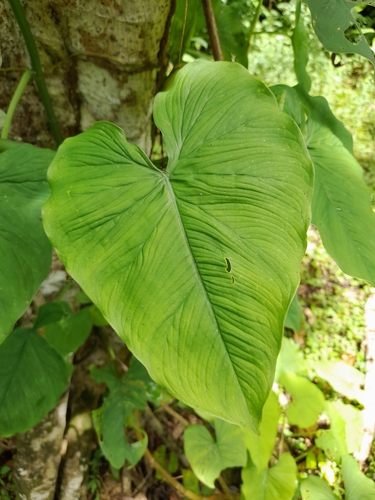
The leaf blade is 30–120 cm in diameter and highly dissected.
Rachis Structure
The rachises are winged only in the distal half of the blade, with sinuous wings.
Leaflet Characteristics
The leaflets are dark emerald green on the adaxial side with a pinkish - violet margin, somewhat obovate or elliptic - oval, 5.5–11 × 2.5–4.5 cm, somewhat fleshy, and long - acuminate.
Leaf Venation
The venation is impressed on the adaxial side.
Inflorescence Arrangement
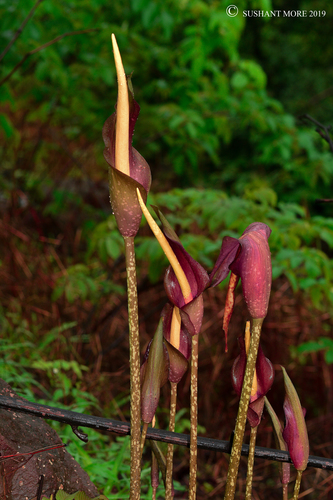
The inflorescence is solitary and long - pedunculate.
Peduncle Characteristics
The peduncle has the same color as the petiole, 38–125 cm long and 1–4 cm in diameter at the base.
Spathe Base Structure
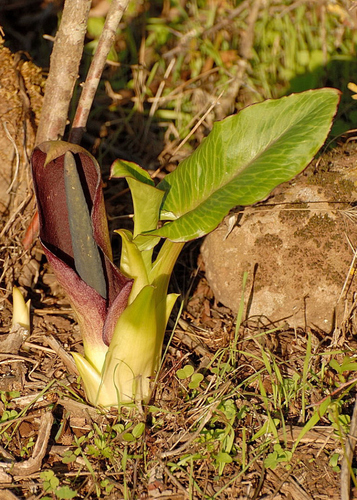
The spathe is strongly convolute at the base.
Spathe Outer Surface
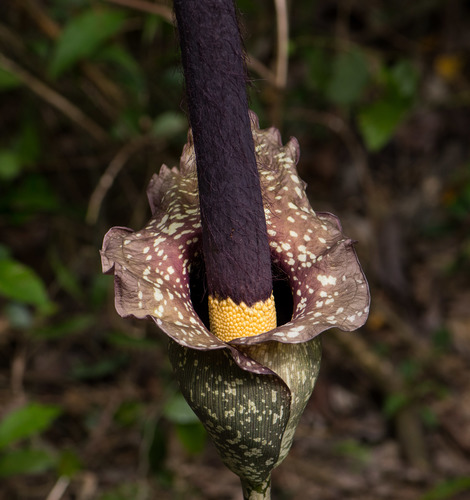
Outside, it is pale green, faintly flushed with purple or dark grayish - green with numerous pale whitish - green spots (proximal ones confluent), and the veins are dark green.
Spathe Inner Surface
Inside, it is blackish maroon, campanulate, constricted between the base and the limb, broadly triangular, 13–53 × 12–45 cm, covered with numerous shortly ridgelike, laterally compressed, fleshy warts.
Spathe Base and Apex
The base is obliquely urceolate, thick - walled, and the apex is acute.
Spathe Limb Orientation
The limb spreads horizontally or turns obliquely upward.
Spathe Limb Outer Surface
Outside, it is pale green, flushed with purple - brown or dark grayish - green with angulate, whitish - green spots and dirty - purple margins without spots.
Spathe Limb Inner Surface
Inside, it is somewhat maroon, flushed with green or with numerous small, rounded, sometimes confluent, whitish - greenish spots, and the veins are maroon, with an undulate margin.
Spadix Odor
The spadix emits a strong smell of old socks or strong compost.
Spadix Dimensions
It is somewhat stipitate, much longer than the spathe, 31–88.5 cm long, with a stipe of 0.2–1 cm.
Spadix Zone Arrangement
The female and male zones are separated by a narrow sterile zone.
Female Zone Characteristics
The female zone is slightly obconic or cylindric, 1.6–6.5 cm long, 1.1–3.5 cm in diameter at the base and 1.2–3.7 cm in diameter at the apex, with lax flowers.
Ovary Structure
The ovary has a white basal half and a blackish - maroon apical half, is somewhat globose, about 2.5 mm high and about 2.5 mm in diameter, orbicular in cross - section, and tapers gradually to the style.
Ovary Locules
It is 2 - loculed, with 1 basal ovule per locule.
Style Characteristics
The style is maroon, thick, about 1 × 1.5 mm.
Stigma Characteristics
The stigma is somewhat pyramidal, orbicular in cross - section, about 1.8 mm high and about 2.5 mm in diameter, shallowly 2(or 3) - lobed, with pale olive - green, rounded, scabrous lobes.
Sterile Zone Flowers
The sterile flowers between the male and female zones consist of 1–7 staminodes, which have a swollen, often depressed, white base and a purple hair 5–10 mm long.
Male Zone Characteristics
The male zone is urceolate, terete or slightly laterally compressed, with a straight or very irregular distal margin, 3–9 cm long, 0.9–3.7 cm in diameter at the base and 2–7 cm in diameter at the apex, with congested flowers and scattered purple hairs between.
Male Flower Composition
The male flowers consist of 3–6 stamens.
Stamen Shape
The stamens are very shallowly hemispheric, about 2 mm.
Uppermost Stamen Variation
Some uppermost stamens are intermediate with hairs on the appendix, with a short hair on the connective or reduced to a slightly concave, broad base with a hair (staminode).
Filament Characteristics
The filaments are short, about 0.5 mm, and connate.
Anther Characteristics
The anthers are about 1.5 × 3–3.5 mm, polygonal in cross - section, with a very shallowly rounded apex, ivory - white, and produce a clear fluid from the top during female anthesis.
Connective Color
The connective is brownish.
Anther Pores
The pores are apical, elongate, and oval after anthesis.
Appendix Characteristics
The appendix is very narrowly conic, 25.5–73 cm long, 2–7 cm in diameter at the base, entirely purple or with numerous dirty greenish, small spots, with numerous laxly disposed hairs directed perpendicular to the appendix axis, 0.2–1.5 cm long, purple, in shallow pockets, with an unswollen base and an obtuse apex, and it produces a clear fluid during female anthesis.