About Solidago multiradiata Aiton
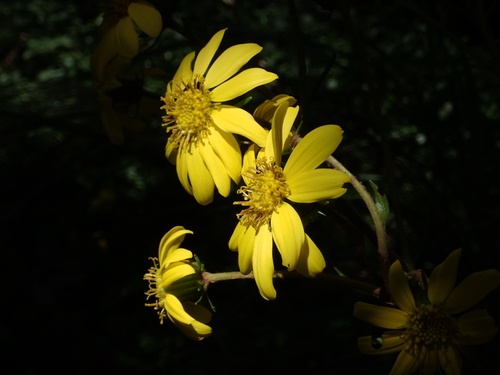
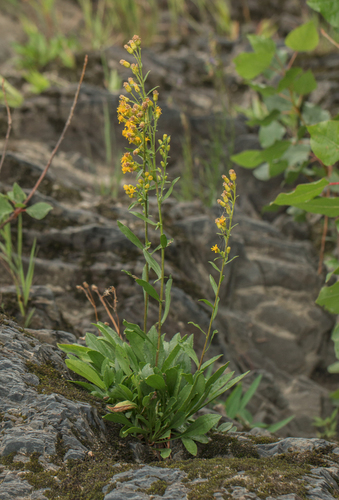
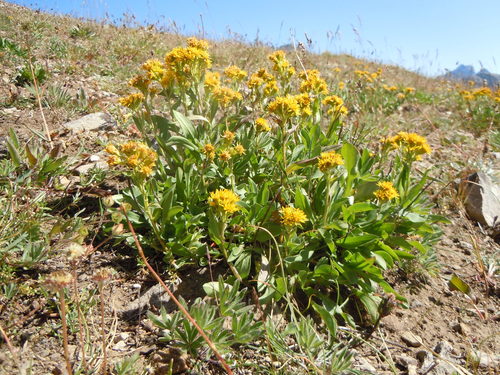
Solidago multiradiata Aiton is a goldenrod species with the common names Rocky Mountain goldenrod, northern goldenrod, and alpine goldenrod. It is native to North America, widespread across the continent’s northern regions. This range includes Alaska, almost all of Canada — all three territories and every province except Prince Edward Island — as well as land north of the Arctic Circle. Its distribution extends south through the western United States to Arizona, New Mexico, and California. This species occurs in the subalpine and alpine climates of high mountain ranges, and its typical habitat includes tundra and mountain meadows. It is a perennial herb that grows one or more decumbent or upright stems from a branching caudex. Stems reach a maximum length or height between 3 and 80 centimeters. Its leaves are lance-shaped or linear; they sometimes narrow significantly at the base to take on a spoon or spatula shape. The longest leaves, up to 20 centimeters long, grow at the base of the plant, while leaves are smaller higher up the stem. Leaves are mostly hairless, but may have hairs along their toothed or serrated edges. The inflorescence is a cluster of multiple flower heads, and clusters can hold up to 100 heads total. Each flower head holds many yellow disc florets, plus narrow yellow ray florets that are each 3 or 4 millimeters long. The fruit is an achene a few millimeters in length. The achene is covered in rough hairs and typically bears a pappus at its tip. This plant has been observed as one of the first species to resprout after oil spills in Alaska, and it is used there for revegetation projects.