About Solenostomus cyanopterus Bleeker, 1854
Species Naming and Size
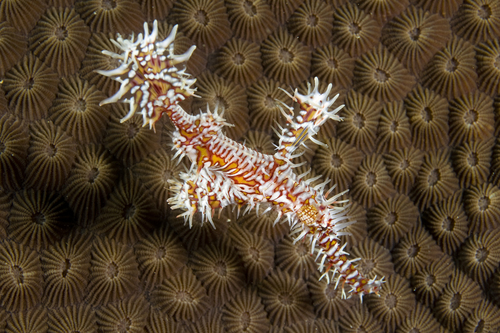
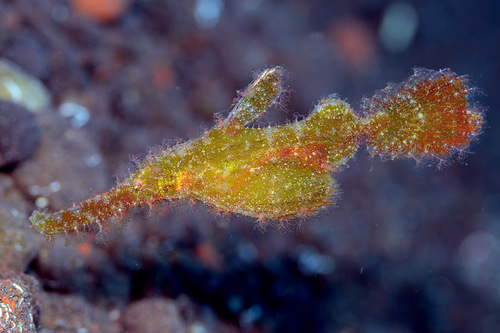
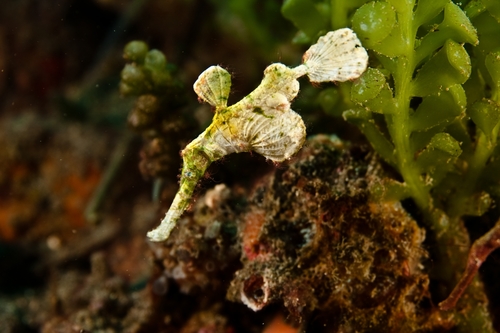
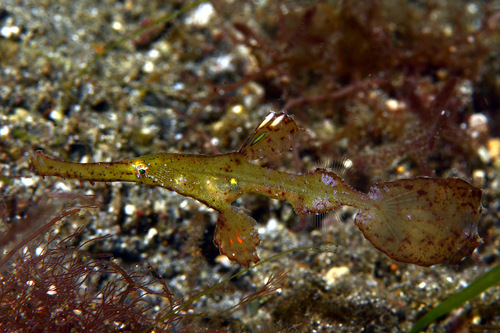
Solenostomus cyanopterus Bleeker, 1854, commonly called the robust ghost pipefish, is the largest species of ghost pipefish. It can reach a maximum total length of 17 cm (6.7 in).
Snout and Jaw Morphology
This species has a long snout with the mouth located at the tip, and its jaws are mostly toothless. It also has a tail that is long relative to its body.
Caudal Fin Structure
The caudal fin may take a truncated, rounded, or lanceolate shape, and the caudal peduncle is very short, and sometimes completely absent. Its overall appearance, featuring a long slender snout and large fins, lets it mimic a piece of drifting seagrass.
Body Coloration Base
The body can be colored gray, brown, pink, yellow, or bright green, marked with small black and white dots. Robust ghost pipefish can change their color gradually over 24 to 36 hours to match their surrounding environment.
Dorsal Fin Markings
Several dark-blue spots are present on the first few spiny rays of the dorsal fin; these spots may look black in preserved specimens.
Skin and Scale Characteristics
The species is largely scaleless, but has 25–35 star-shaped (stellate) bony plates across its skin. The lateral line is not visible.
Geographical Range
This species is found in the Red Sea and throughout the tropical Indo-Pacific, ranging from the coast of East Africa to Fiji, southern Japan, and Australia. Within this broad range, it can adapt to a variety of habitats.
Habitat and Depth Range
Larvae and young individuals are mostly pelagic, while adults inhabit coastal reefs and weedy areas at depths between 2 and 25 m (6 ft 7 in to 82 ft 0 in). Preferred substrates for adults include coral, vegetation, and sand.
Temperament and Escape Behavior
The robust ghost pipefish is a slow-moving, placid species. When disturbed, it typically moves into nearby shelter, such as seagrass for extra camouflage or coral for protection.
Lifespan Trait
It has a relatively short lifespan, and dies after a single reproductive event.
Reproductive Parental Care
Among all fishes in the order Syngnathiformes, this genus (Solenostomus) is unique because females, not males, care for the eggs. In females, the two pelvic fins fuse together to create a brood pouch that protects the eggs.
Mating System
Each robust ghost pipefish reproduces only once in its lifetime, and mating pairs stay together for life.
Egg Incubation Process
Egg envelopes attach to small skin extensions that only exist in female specimens, so eggs can incubate safely inside the brood pouch. When the eggs are ready to hatch, the female releases them into the water column, where newly hatched larvae drift along with currents.
Larval Characteristics
The larvae are well-developed when released, measuring approximately 3 mm long, with fully formed eyes, mouths, and spines.