About Sisymbrium irio L.
Species Common Name & Habit
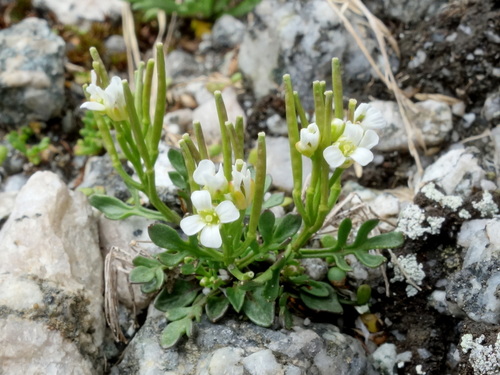
Sisymbrium irio L., commonly known as London rocket, is a variable-sized winter annual herb.
Size Variation by Range
In Britain, it can grow as a large leafy plant reaching up to 130 centimetres (51 in) tall, while in its native Arabia it grows only as a small rosette-forming plant around 10 cm (4 in) tall.
Stem Characteristics
It has an erect, usually branched green stem that is terete, solid, and nearly hairless, with only a scattering of soft short hairs up to 0.5 millimetres (1⁄32 inch) long.
Leaf Arrangement & Structure
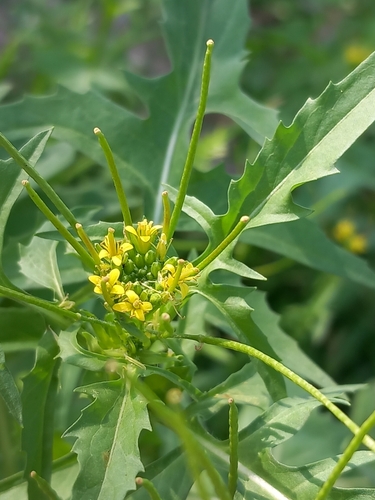
Its leaves are alternate, and either imparipinnate or pinnatisect, growing up to 18 cm (7 in) long. Each leaf has 1 to 5 pairs of lateral lobes, plus a round or ternate terminal lobe.
Leaf Petiole Features
Leaf petioles reach up to 6 cm (2+1⁄4 in) long, are channelled, slightly decurrent down the stem, and lack stipules.
Leaf Surface & Flavour
Leaves are finely hairy on both surfaces, uniformly green aside from a pale midrib, and have a peppery flavour.
Flower Arrangement & Size
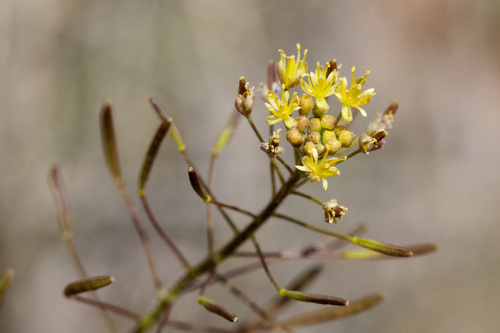
The actinomorphic flowers are around 5 mm (1⁄4 in) in diameter, arranged in racemes of 50 to 100 or more at the tips of the main stem and branches.
Flower Anatomy
Each flower has 4 yellow petals, 4 green finely hairy sepals that are nearly as long as the petals, and 6 stamens.
Flowering Pedicel Traits
The flower stalks, called pedicels, are short at flowering time, producing a fairly flat-topped, crowded inflorescence. As the fruits develop, the pedicels elongate, and the developing fruits quickly overtop the flowers.
Fruit Morphology
The fruit is a long narrow cylindrical silique 3–8 cm long that remains green when ripe, and is slightly torulose, meaning it has small lumps at the position of each seed, giving it an appearance like a string of beads. The fruits are held at a divergent angle to the stem on long, thin, hairy pedicels.
Seed Characteristics
When dried, each of the two silique valves contains a single row of small red oblong seeds around 1 mm across. Each pod holds around 100 seeds, so a single plant can produce a total of many tens of thousands of seeds.
Similar Species Confusion
London rocket can be easily confused with other Sisymbrium species.
Distinguishing Identification Traits
Distinguishing characteristics to identify it include its compact flower head, the way developing seedpods extend above the open flowers, and its long thin pedicels that are narrower than the fruits.
Native Range
London rocket is thought to be native to the Middle East, ranging east as far as northwest India or Mongolia, and west across North Africa and southern Europe.
Introduced Distribution
It has been introduced to North America, where it is considered a pest species in the southern United States and Mexico, as well as to South America, Australasia, southern Africa, and eastward to Korea and Japan.
Global Conservation Status
Its international conservation status has not been evaluated, but it is not considered at risk in most of the countries where it occurs, and is classified as Least Concern.
British Introduction History
It was introduced to Britain by the 1650s, and has maintained a scattered distribution there ever since.
British Population Dynamics
It does not tend to persist in one site for very long; it was even believed to have disappeared from London by the late 19th century, and was only reintroduced in the 20th century.
British Habitat Occurrences
It arrives through docks and other transport hubs, and was historically found in fields treated with wool shoddy.
British Population Trend Perception
Overall, its British population has stayed roughly stable for centuries, but its transient nature means more sites have held the species than are occupied at any one time, which has led to the incorrect impression that it is constantly declining.
South Korea Colonization
One country the species has recently colonized is South Korea, where it has been closely studied.
South Korea Spread Pattern
It first arrived at the port of Busan, and spread 1.5 kilometres (0.9 mi) along a roadside over 10 years. It is currently classified as established but not invasive in South Korea.
Associated Herbivorous Insects
The Database of Insects and their Food Plants records only two insect species that use London rocket: Ceutorhynchus hirtulus, a weevil that lives in soil and creates stem galls for its larvae, and cabbage looper moth, whose larvae eat the leaves of London rocket and many other cabbage family species.
Weed Status
This species is considered a weed in the Southwestern United States and other introduced regions.
Livestock Fodder Use
In desert regions of Arabia and Egypt, London rocket is an important source of fodder for livestock.
Edible Human Uses
Its leaves, seeds, and flowers are edible for humans, with a spicy flavour similar to cultivated rocket.
Traditional Medicinal Uses
In the Middle East, it is used to treat coughs and chest congestion, relieve rheumatism, detoxify the liver and spleen, reduce swelling, and clean wounds.
Tobacco Substitute Use
Bedouin people of the Sinai Peninsula and Negev desert reportedly used London rocket leaves as a tobacco substitute.
Alkaloid Content Research
A recent study of alkaloid content in desert-grown plants from Iraq found a high concentration of nicotine in extracts of the plant’s aerial parts.
Pod Preparation for Food
Cured pods can be placed in a basket with live coals and shaken until parched, then ground into meal to use in soup or stew.