About Silaum silaus (L.) Schinz & Thell.
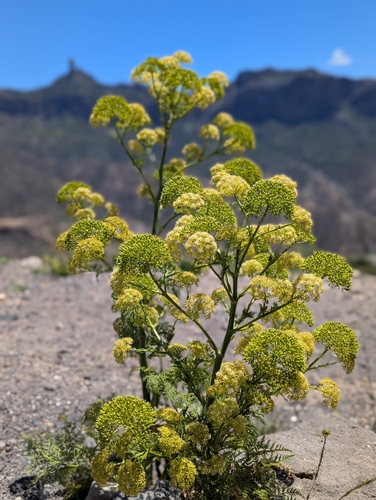
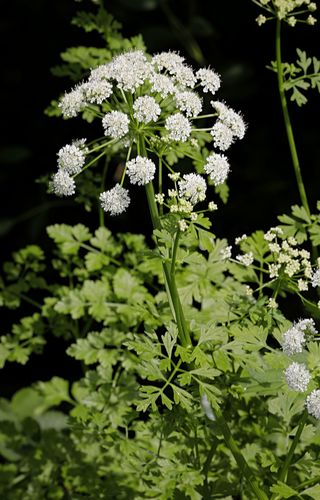
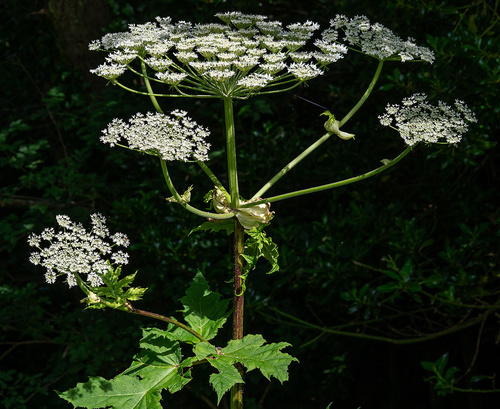
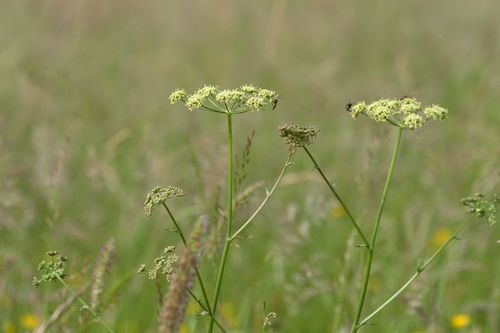
Silaum silaus, formally named Silaum silaus (L.) Schinz & Thell., is an erect, hairless umbellifer species with woody, stout, cylindrical tap roots that are hot and aromatic. The top portions of its petioles are dark grey or black, and petiole remnants remain at the base of its solid, striate stem. Its compound umbels are 2–6 cm in diameter, grow either terminally or axillary, and hold 4 to 15 angled rays that measure 1–3 cm. The peduncle is larger than the rays, and both structures are papillose. Most of its flowers are hermaphroditic. The species has 2–4-pinnate leaves with a triangular to lanceolate outline and a long petiole; its primary leaf divisions grow on long stalks. Leaf segments are 10–15 mm long, range in shape from lanceolate to linear, and have acuminate or obtuse, mucronate tips. The leaf blades are finely serrulate with a prominent midrib, and the leaf apex is often reddish in colour. Upper cauline leaves are 1-pinnate, are either simple or reduced to a sheath, lack a petiole, and the species' cotyledons taper at their base. This umbellifer has 0–3 bracts and 5–11 bracteoles, and its pedicels are linear-lanceolate with scarious margins. Its flowers are yellowish, 1.5 mm across, have no sepals, and the styles form a stylopodium; stigmas are capitate. Fruits are 4–5 mm long, oblong-ovoid, and rarely compressed. They have a broad commissure, prominent mericarps with slender ridges, and lateral ridges that form narrow wings; a carpophore is present. Numerous vittae are found in the fruit, and the stout pedicels are 2–3 mm long. Silaum silaus occurs in western, central, and south-eastern Europe, including Great Britain, and ranges north to the Netherlands and Sweden, but is not found in Portugal. In Great Britain, it occurs mainly south of the far south of Scotland. It is listed as an invasive species in Denmark. It grows in a wide range of habitats, and generally favours locations with damper soils. Specific habitats it occupies include unimproved neutral grassland, railway and road verges, and meadows including hay meadows, water meadows, and lowland meadows. It is also occasionally found on chalk downs and vegetated shingle. It acts as an indicator species for agriculturally unimproved meadows. In the United Kingdom, it is part of a group of flowering plants specifically associated with neutral grassland growing under low-nutrient conditions. This group of plants is declining in the UK due to agricultural improvement, diffuse pollution, and habitat fragmentation, so Silaum silaus is included in the United Kingdom Biodiversity Action Plan. In the UK, at least three moth species have larvae that feed on this plant as a food source: Sitochroa palealis, Agonopterix ciliella, and Agonopterix yeatiana. Fruit fossils of Silaum silaus have been identified from substage III of the Hoxnian interglacial period, a middle Pleistocene stage, in the British Isles. In 1640, John Parkinson recorded in his work Theatrum Botanicum that Silaum silaus could soothe "frets" in infants.