About Sigmodon ochrognathus Bailey, 1902
Captive Size and Sexual Dimorphism
When kept in captivity, male yellow-nosed cotton rats reach a maximum head and body length of approximately 155 mm (6 in), while females are slightly shorter and heavier. No notable sexual dimorphism has been observed in wild populations.
Head and Tail Morphology
This species has a short, broad head and a hairy tail covered in many small scales no wider than 0.5 mm (0.02 in).
Dorsal and Facial Coloration
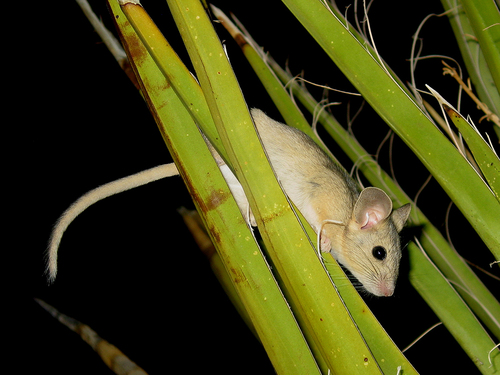
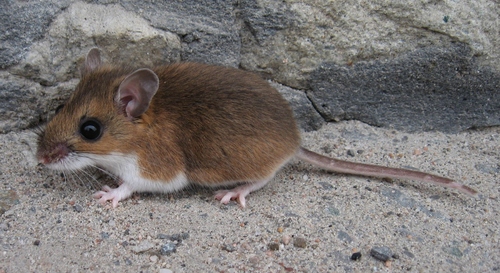
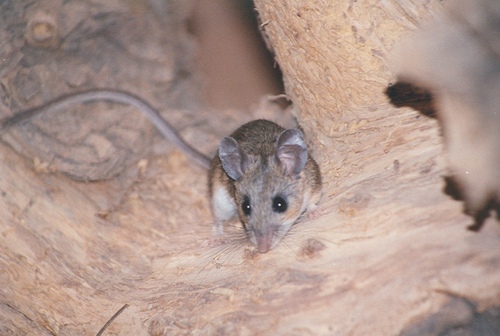
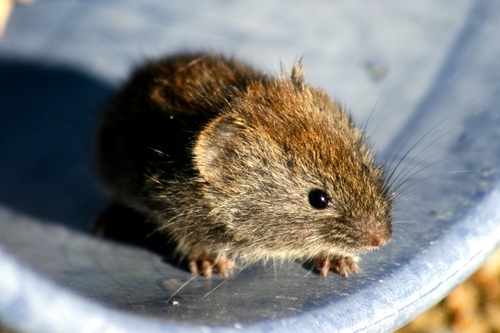
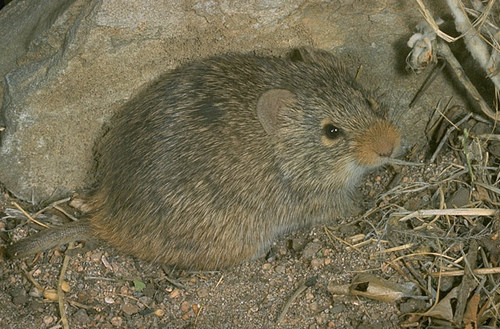
The fur on its head, back, and sides is dull gray; the distinguishing features that separate it from other species in the genus Sigmodon are its ochre snout and an ochre ring surrounding each eye.
Ventral and Appendage Coloration
Its underparts are grayish-white, its feet are grayish-buff, the upper side of its tail is blackish, and the underside of its tail is gray.
Overall Native Range
The yellow-nosed cotton rat is native to Mexico and the U.S. states of Arizona, New Mexico, and Texas.
Mexican Distribution
In Mexico, its range stretches from the eastern side of the Sierra Madre Occidental to central Durango and western Coahuila.
United States Distribution
In the United States, its range extends from Arizona to New Mexico, and includes scattered desert ranges of the Mesa del Norte in trans-Pecos Texas.
Occupied Habitat Types
It inhabits mountainous areas that contain grassy meadows, rocky slopes, shrubland, ponderosa pine forest, Douglas fir forest, and pinyon-juniper woodland.
Altitudinal Range and Dry Adaptation
It is generally found on lower, drier slopes at altitudes below 1,950 m (6,400 ft), and is the most xerophilous (dry-adapted) species in its genus.
Interspecific Competition
The yellow-nosed cotton rat does not compete effectively with other cotton rat species, such as the white-eared cotton rat (Sigmodon leucotis).
Habitat in Overlapping Ranges
Where their ranges overlap, it occupies thinly vegetated, rocky slopes with grass tussocks.
Arizona Habitat Flora
In Arizona, it is commonly found on open slopes scattered with Emory oak, Arizona oak, alligator juniper, yucca, agave, mimosa, sugar sumac, prickly pear, and desert spoon.
Cover Source
These plants typically grow long foliage at their bases, which the cotton rat uses for cover.
Sympatric Species and Shelter
It shares its habitat with the fulvous harvest mouse (Reithrodontomys fulvescens) and the southern pocket gopher (Thomomys umbrinus), and uses the abandoned burrows of the southern pocket gopher, as well as cavities under boulders.
Habitat in Exclusive Ranges
In localities where it is the only cotton rat species present, the yellow-nosed cotton rat lives in grassy meadows and alluvial fans with deeper soil.
Runway Construction
In these habitats, it creates runways between clumps of grass, but these paths are hard to distinguish in sparsely vegetated areas.
Activity Pattern and Anti-predator Behavior
It is primarily active during the day, and moves quickly along its runways to minimize the time it is exposed to predators.
Diet Composition
It feeds mainly on blue grama grass (Bouteloua gracilis), but also eats the green parts of other plants including muhly, three-leaf groundsel, gumweed, and three-awn tangle-head; it consumes seeds and fruits less often.
Food Storage Behavior
It cuts sections of grass to form small piles of grass blades on the ground surface, and stores additional piles of dried foliage underground, often in the abandoned burrows of southern pocket gophers.