About Serruria elongata (P.J.Bergius) R.Br.
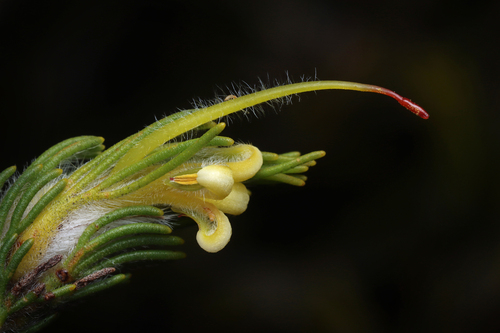
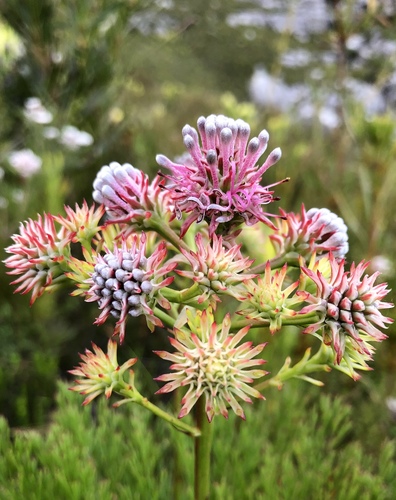
Serruria elongata, commonly called long-stalk spiderhead, is a small hairless shrub that reaches 1–1.5 m (3.5–5 ft) in height, with upright or ascending stems. Its leaves are arranged in an apparent whorl at the base of the inflorescence stalk, and measure 5–12.5 cm (2.0–4.9 in) long. Leaves are divided two or more times into a feather-like shape in the upper half to upper third of the blade, producing around sixty segments. Leaves are hairless, though young leaves may sometimes have a felty texture. The highest-order leaf segments are roughly 1 mm (0.039 in) thick, cylindrical, with a blunt tip that bears a pointed extension of the midrib. Each main inflorescence stalk holds five to twenty-five flower heads, arranged in a panicle or corymb structure. The common inflorescence stalk extends far above the leaves, is hairless, and measures 15–30 cm (6–12 in) long. Primary branches of the inflorescence stalk reach up to about 6 cm (2 1/4 in) in length, and most hold multiple flower heads. Each flower head is subtended by a lance-shaped bract 4–8 mm (0.16–0.31 in) long, with a pointed (acute or acuminate) tip. The stalks holding individual flower heads are 4–6 mm (0.16–0.24 in) long, hairless, and either lack a bract or bear only a very small bract. Individual flower heads are roughly 1.5 cm (0.6 in) across. The hairless bract that subtends each individual flower is purple in colour, about 6 mm (0.24 in) long and 3 mm (0.12 in) wide. This bract has a rounded body from which a thick midrib extends into a long, elongated tip. Silvery flowers remain straight while in bud. This species has a 4-merous perianth. The lower fused portion of the perianth (called the tube) is 3 mm (0.12 in) long, hairless, and quickly splits all the way to its base. The middle portion consists of four segments that become free as soon as the flower opens (called claws); these are magenta-pink, 6.5–8 mm (1/4–1/3 in) long, very narrowly spade-shaped, and covered in short hairs pressed against the surface. The upper portion is made of four segments (called limbs), each 2 mm (0.079 in) long, narrowly oblong, with an almost pointed tip and a covering of felty hairs. Each limb is directly connected to a felty hairy, linear anther 1.5 mm (0.059 in) long. The felty ovary is roughly 1 mm (0.039 in) long. It extends into a cylindrical, hairless style about 6.5 mm (0.26 in) in length. The style is topped by a blunt, oblong or nearly hoof-shaped stigma around 1 1/3 mm (0.052 in) long, which is slightly thicker than the style. The one-seeded fruit sits on a short stalk, is roughly 2 mm (0.079 in) long, more or less egg-shaped, has a short beak, and is covered in rust-coloured hairs. This species occurs from Du Toitskloof, between Paarl and Worcester in the northwest, to the area around Cape Agulhas in the southeast. It grows at elevations of 100–650 metres (330–2,130 ft) in fynbos vegetation, on sandy soils formed from the weathering of acid sandstones. Flowers of Serruria elongata produce a strong sweet scent that resembles jasmine, late in the afternoon. No scent is detected earlier during daylight hours. This sweet scent produced around dusk suggests this species may be pollinated by moths. Fruits are collected by ants, and seeds stay dormant until the spring that follows a summer bushfire.