About Seriola zonata (Mitchill, 1815)
Adult Coloration
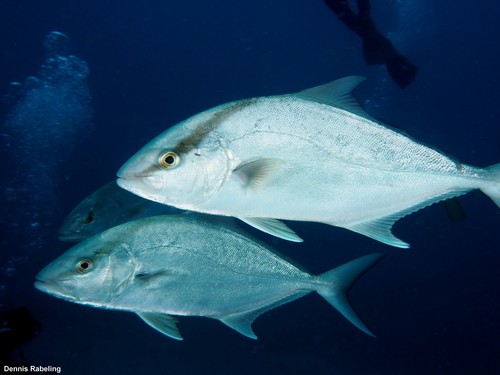
Adults of the banded rudderfish (Seriola zonata) are bluish, greenish, or brown in color, and do not have any dark vertical bars.
Fin Proportions
The second dorsal fin is roughly twice the length of the anal fin.
Caudal Fin Features
The dark lobes of the caudal fin have white tips.
Juvenile Body Markings
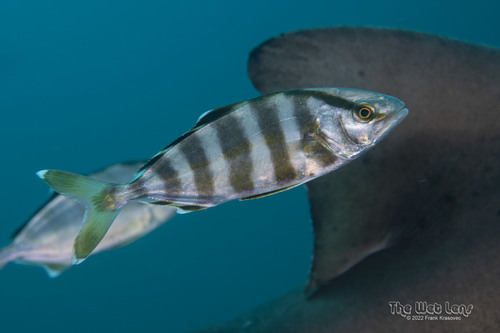
Juveniles have six dark transverse bars along their flanks, and a dark stripe that runs from the eye to the first dorsal fin.
Juvenile Fin Coloration
The dorsal fin is dark, with an indistinct white margin on the second dorsal fin, while the lobe and margin of the anal fin are white.
Stripe Patterns
This species frequently has an amber stripe running from the snout along the flank, and often has an additional dark stripe that runs from the eye to a point in front of the first dorsal fin.
Body Shape
It has an elongated, fusiform, compressed body with a long, pointed snout.
Maximum Size
This species can reach a maximum length of 78 centimetres (31 in) and a maximum weight of 5.2 kilograms (11 lb).
Seriola zonata was formally described in 1815 as Scomber zonatus by American physician, naturalist, and politician Samuel L. Mitchill (1764–1831), with the type locality given as New York Bay, New York.
Geographical Range
The banded rudderfish occurs in the western Atlantic Ocean, where it is found from Nova Scotia to Santos, São Paulo.
Unconfirmed Presence
Its presence in Cuba has not yet been confirmed.
Depth Range
The banded rudderfish is a benthopelagic fish that occurs at depths between 3 and 360 metres (9.8–1,181.1 ft).
Habitat Preferences
It occurs over hard substrates in both inshore and offshore waters, but normally lives in shallower water than other species in the same genus.
Juvenile Associations
Juveniles are found associated with floating mats of seaweed or debris, and are known to follow sharks and other large fishes.
Jellyfish Association
Juveniles have also been recorded living in association with jellyfish.
Adult Diet
Adults feed on fish and crustaceans.
Spawning Habits
Spawning occurs year-round in offshore waters.