About Seringia arborescens (W.T.Aiton) Druce
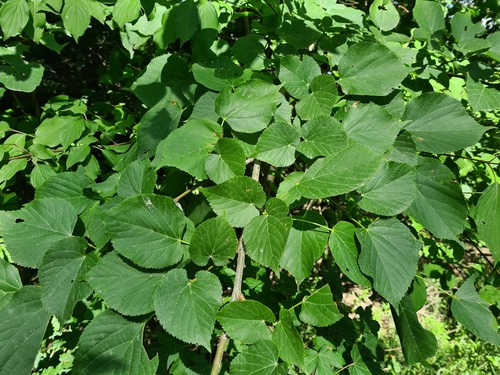
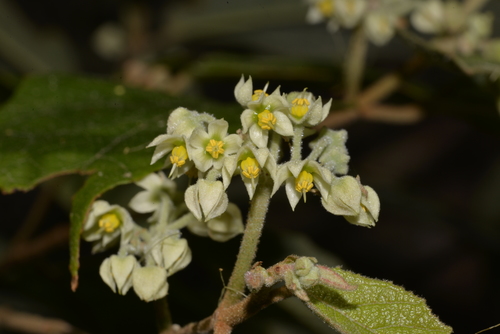
Seringia arborescens (W.T.Aiton) Druce is an erect, spreading shrub that usually reaches 2 to 4 meters (6 feet 7 inches to 13 feet 1 inch) in height and 2 meters (6 feet 7 inches) in width, though it occasionally grows as a small tree up to 8 meters (26 feet) tall. Its young branches are covered in rust-colored, woolly hairs. Leaves of this species are egg-shaped to lance-shaped, measuring 50 to 150 millimeters (2.0 to 5.9 inches) long and 15 to 60 millimeters (0.59 to 2.36 inches) wide. Each leaf sits on a petiole 5 to 10 millimeters (0.20 to 0.39 inches) long, with narrow stipules 2 to 4 millimeters (0.079 to 0.157 inches) long at the petiole base. The upper surface of the leaves is more or less hairless, while the lower surface has raised veins and a dense covering of fine, star-shaped hairs. The flowers are cream-colored or greenish-white, arranged in cymes of 10 to 40 flowers on a hairy peduncle 2 to 12 millimeters (0.079 to 0.472 inches) long. Each individual flower grows on a hairy pedicel 3 to 7 millimeters (0.12 to 0.28 inches) long, with bracts less than 5 millimeters (0.20 inches) long that fall off when the flowers open. The sepal lobes are 3 to 5 millimeters (0.12 to 0.20 inches) long, densely hairy on the outer surface and more or less hairless on the inner surface. This species has no petals, but does have 5 tiny staminodes, and its anthers are yellow. Flowering takes place from June to October. The fruit is a capsule 5 to 10 millimeters (0.20 to 0.39 inches) in diameter, covered in rust-colored hairs. Seringia arborescens grows in forest, often along river banks, and is found in near-coastal areas from Danbulla in Queensland to Ulladulla in New South Wales.