About Durio zibethinus Murray
Wood Characteristics
Durio zibethinus Murray, commonly known as durian, has reddish brown wood.
Pollination
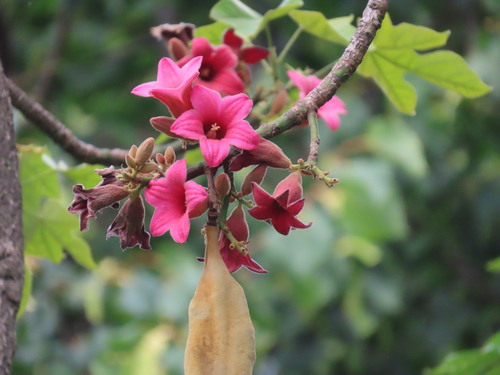
For its ecology, bats visit this species' flowers to eat pollen and act as pollinators.
Flower Development
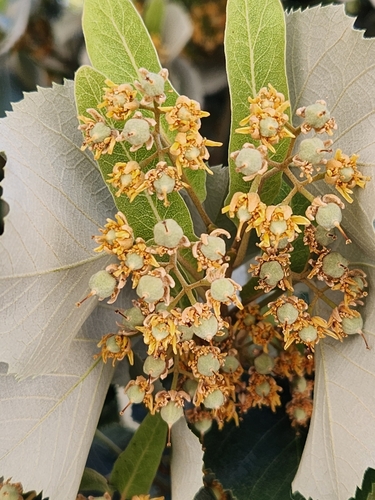
The flowers open in the afternoon, shed pollen in the evening, and by the following morning, the calyx, petals, and stamens have all fallen off, leaving only the flower's gynoecium.
Southeast Asian Cultivar Origins
Over centuries, numerous vegetatively propagated durian cultivars of this species have developed in southeast Asia.
Propagation Methods
Originally, cultivars were grown from seeds of trees that produced superior quality fruit, with inconsistent results; today they are propagated via layering, marcotting, or most commonly grafting (including bud, veneer, wedge, whip or U-grafting) onto seedlings of randomly selected rootstocks.
Fruit Shape Variation
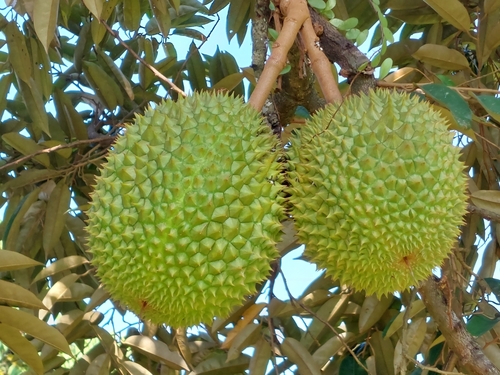
Different cultivars can be partially distinguished by variation in fruit shape, including the shape of the fruit spines.
Cultivar Market Value
Durian consumers prefer specific cultivars, which command higher market prices.
Cultivar Naming Convention
Most cultivars have a common name and a code number starting with "D".
Popular Cultivar List
Popular cloned cultivars include Kop (D99), Chanee (D123), Berserah (also called Green Durian or Tuan Mek Hijau, D145), Kan Yao (D158), Mon Thong (D159), Kradum Thong, and the unnamed cultivars D24 and D169.
Cultivar Sensory Traits
Each cultivar has a unique taste and odour.
Thailand Cultivar Count
More than 200 cultivars of Durio zibethinus exist in Thailand.
Mon Thong Traits
Mon Thong is the most commercially desirable, with thick, full-bodied creamy, mild sweet flesh, a relatively moderate scent, and smaller seeds.
Chanee Disease Resistance
Chanee has the best resistance to infection by Phytophthora palmivora.
Kan Yao Traits
Kan Yao is less common, but valued for having an extended period when it is both sweet and odorless.
Thai Commercial Cultivars
Currently, five cultivars are grown on a large commercial scale in Thailand: Chanee, Mon Thong, Kan Yao, Ruang, and Kradum.
Malaysia Cultivar Registration
In Malaysia, more than 100 cultivars have been registered since the 1920s, and there were up to 193 cultivars by 1992.
Malaysian Cultivar Selection
Many superior cultivars have been identified through competitions held at the annual Malaysian Agriculture, Horticulture, and Agrotourism Show.
Vietnamese Cultivar Practices
In Vietnam, cultivar identification is done through competitions run by the Southern Fruit Research Institute, and the Musang King variety has recently grown in popularity.
Chantaburi No. 1 Hybrid
By 2007, Thai government scientist Songpol Somsri crossbred more than ninety durian varieties to develop Chantaburi No. 1, an odourless cultivar that lacks the characteristic durian scent.
Chantaburi No. 3 Hybrid
Another hybrid, Chantaburi No. 3, only develops its odour around three days after picking, allowing odourless transport while still satisfying consumers who prefer the typical pungent durian odour.
Laplae Cultivar Presentation
On 22 May 2012, two additional odourless Thai cultivars, Long Laplae and Lin Laplae, were publicly presented by Yothin Samutkhiri, the governor of Uttaradit Province where these cultivars were developed locally; he also announced the dates for the annual Laplae District durian fair and confirmed the official names of both new cultivars.
Edible Seeds
Besides the edible fruit pulp, the seeds of Durio zibethinus can also be eaten after roasting.