About Sericocarpus tortifolius (Michx.) Nees
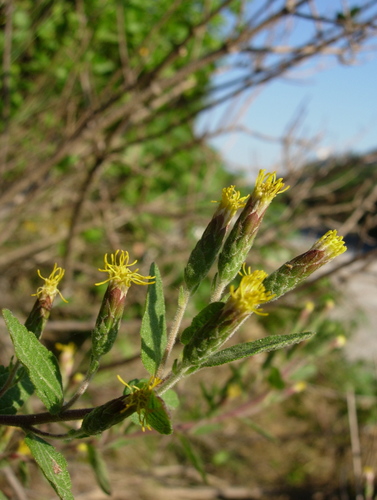
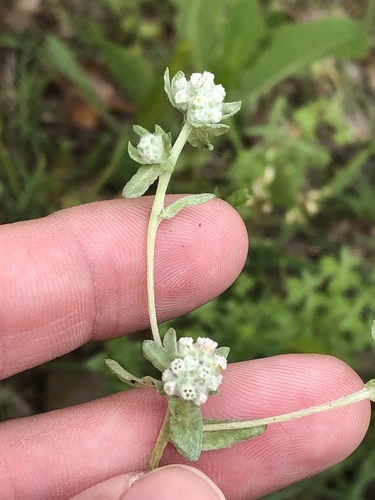
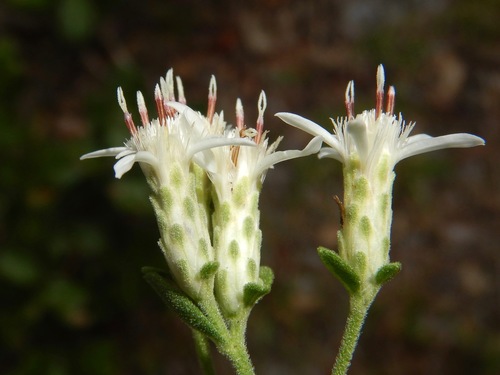
Sericocarpus tortifolius (Michx.) Nees grows 33 to 117 centimeters tall, and produces erect, hairy stems. By the time the plant flowers, its lower and basal leaves have typically withered, while upper stem leaves (cauline leaves) are sessile. Leaf blades are obovate, measuring 10 to 40 millimeters long and 3 to 10 millimeters wide, with smooth entire margins and pointed to slightly tipped ends. Both the upper and lower surfaces of the leaves are hairy and resinous. Flower heads grow in clusters of 2 to 4 per branch, arranged in flat-topped corymbiform arrays. Bracts on the flower stalks are broad, hairy, and range from lance-shaped to ovate. The involucre is 5 to 8 millimeters long, and holds phyllaries arranged in 4 to 5 overlapping rows that increase in size toward the center: outer phyllaries measure 2 to 3 millimeters long, while inner phyllaries can reach up to 6 millimeters long, and all phyllaries are lightly hairy. Each flower head contains 2 to 5 ray florets, with corolla tubes 3 to 4 millimeters long and ray petals 3 to 6 millimeters long. It also holds 6 to 11 disc florets, with corolla tubes 4 to 6 millimeters long and lobes 1 to 2 millimeters long. Ovaries are spindle-shaped to obconic, 1 to 3 millimeters long, densely covered in stiff hairs, and topped with a pappus of fine bristles 6 to 8 millimeters long. Sericocarpus tortifolius is distributed from eastern North Carolina south to South Florida, and west to eastern Louisiana. It is mostly restricted to the Coastal Plain, but occurs inland in hard-rock provinces of north-central Georgia and north-central Alabama. It grows in dry to mesic longleaf pine sandhills, mesic to scrubby flatwoods, and other dry woodlands.