About Serapias vomeracea (Burm.f.) Briq.
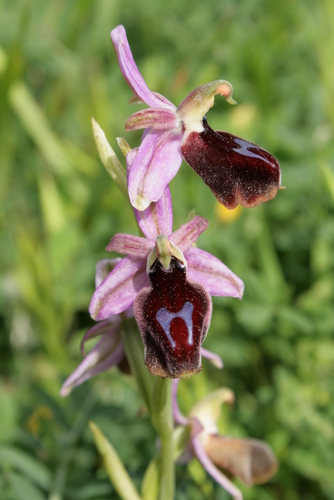
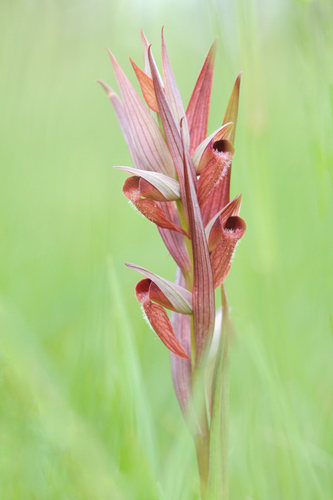
Serapias vomeracea (Burm.f.) Briq. is an herbaceous perennial orchid that grows from two ovoidal underground tubers. This species is highly variable in both flower color and plant shape. It typically grows 20 to 40 centimetres (7.9–15.7 in) tall, and may reach a maximum height of 60 centimetres (24 in). The stem is green, it bears two membranous basal leaves, plus 6 to 8 upper leaves that are lanceolate, glossy, and colored either green or reddish. The inflorescence forms a narrow, elongated spike that holds three to ten flowers. The associated bracts are lanceolate, and are much longer than the flower tepals; they are red-purple with darker longitudinal veins. The outer tepals are lanceolate and erect, forming a structure that looks like a helmet; they are purple-red or pinkish, with darker colored veins. The inner lateral tepals are brownish-purple, and are almost entirely hidden inside the helmet. The labellum, which is larger than all other tepals, is brick red and divided into three lobes. The basal portion of the labellum (called the hypochile) is concave and enclosed within the helmet, and it has two raised, hairy lateral lobes. The apical portion of the labellum (the epichile) is triangular-lanceolate, usually purple-red, and quite hairy. No spur is present on this species. Its flowering period runs from March to June. This species has a Mediterranean-Atlantic distribution, ranging north to Charente, and is widespread from south-central Europe and the Mediterranean Basin through to Cyprus. This orchid grows in dry meadows, wet meadows, pastures, thickets, clearings, and scrubland. It grows most frequently on clayey substrate, tolerates conditions from full sun to partial shade, and occurs at altitudes between 0 and 1,200 metres (0–3,937 ft) above sea level. Serapias vomeracea is pollinated by insects (entomophilous), but it does not produce nectar, so it cannot offer any floral rewards to its pollinators. Instead, pollinators are attracted by the shape of the flower: the flower forms a small tube that insects use as an overnight resting place or a shelter from rain. During this process, pollen sticks to the pollinators' bodies. When the insects leave the shelter, they deposit the pollen on other flowers and fertilize them. These orchids are mainly pollinated by certain beetles from the families Oedemeridae and Lymexylidae, and by bees from the genera Ceratina, Eucera, and Osmia. Their seeds are dispersed by wind, a method called anemochory.