About Eriochilus cucullatus (Labill.) Rchb.f.
Species Identity and Growth Form
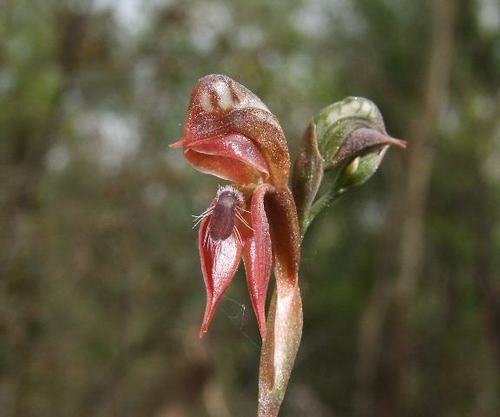
Eriochilus cucullatus (Labill.) Rchb.f., commonly called parson's bands, is a terrestrial, perennial, deciduous herb that grows from an underground tuber.
Leaf Characteristics
This species produces a single egg-shaped, dark green leaf that is slightly rough and hairy. The leaf does not reach full development until after flowering, when it measures 15–35 mm (0.6–1 in) long and 7–12 mm (0.3–0.5 in) wide.
Inflorescence Structure
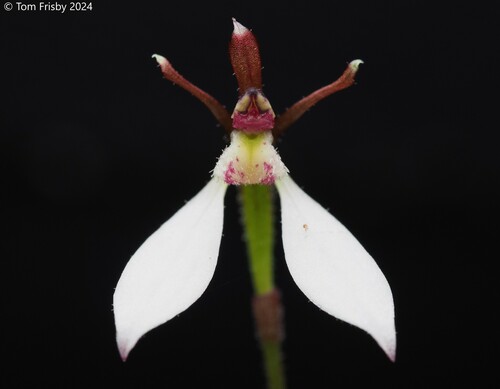
Up to five white to pale pink flowers are borne on a slender spike that grows 100–250 mm (4–10 in) tall. Individual flowers are 15–20 mm (0.6–0.8 in) long and 12–15 mm (0.5–0.6 in) wide.
Dorsal Sepal Morphology
The dorsal sepal is spoon-shaped to lance-shaped, with the narrower end oriented toward its base; it is 5–8 mm (0.2–0.3 in) long, about 2 mm (0.08 in) wide, and forms a hood over the column.
Lateral Sepal Morphology
The enlarged lateral sepals are 10–13 mm (0.4–0.5 in) long, 3–4 mm (0.1–0.2 in) wide, and colored white to pale pink.
Petal Morphology
The petals are reddish-green, 6–7 mm (0.2–0.3 in) long, about 1 mm (0.04 in) wide, and slightly enlarged near the tip.
Labellum Morphology
The labellum is white, green, or yellowish, 6–8 mm (0.2–0.3 in) long, about 3 mm (0.1 in) wide, and fleshy, with tufts of short red and white hairs.
Flowering Period
Flowering occurs from December to June.
Distribution Range
Parson's bands is widespread across Tasmania, Victoria (excluding the far north-west), eastern New South Wales extending west to Grenfell, south-east Queensland, and south-east South Australia.
Habitat Preferences
It grows in a wide range of habitats, from grassland to forest, and from coastal areas to subalpine zones.
Cultivation Notes
Eriochilus cucullatus is sometimes grown in pots by orchid enthusiasts, but it requires specialist cultivation techniques.