About Serapias parviflora Parl.
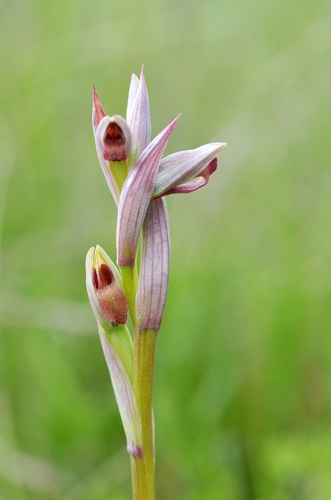
Serapias parviflora Parl. typically grows 10–30 centimetres (4–12 in) tall, and occasionally reaches up to 40 cm (16 in). It has 4–7 keeled, linear leaves at the base of its stem, with 1–3 additional bract-like leaves higher on the stem. Its flowers, which number 3–8 and rarely up to 12, are arranged in a spike. The greyish-pink sepals and petals form a hood over the column and the lip, which is typically 14–19 mm (0.55–0.75 in) long. Serapias parviflora is native across the Mediterranean Basin from the Iberian Peninsula to the Aegean Sea; it is also native to the Canary Islands and along the Atlantic coast of France. It was first found in the United Kingdom in 1989 at Rame Head in Cornwall, where it may have arrived via natural dispersal. This original Cornish colony died out after 20 years. In 2021, 16 plants were discovered growing on the 11th-floor biodiverse green roof at Nomura International's office building in the City of London. The orchid population at this site grew to over 29 individuals in 2022, 40 in 2023, and over 300 individual plants by early 2024, a growth supported by careful management of the green roof by the bank's ecologist. Examination of records for the source materials used to construct the green roof shows the materials were not sourced from anywhere within the orchid's natural range. The most plausible explanation for how the orchids arrived is wind-carried seed transported by a weather pattern similar to the Saharan dust storms that frequently reach the City of London in spring. The timing of the orchid's flowering and seeding in the southern Mediterranean and North Africa aligns with the timing of late spring Saharan dust storms over London. Nomura is working with Kew Science laboratories and mycologists to study the orchids, with the goal of learning more about their arrival in the future.