About Caladenia flava R.Br.
Nomenclature and Basic Growth Form
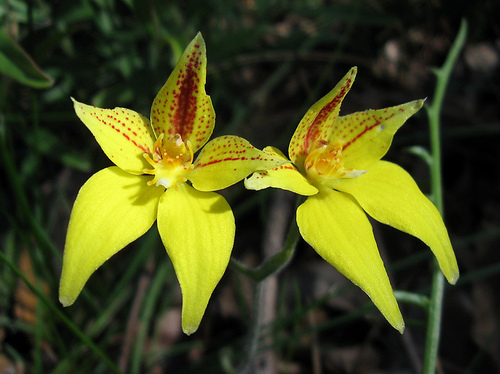
Caladenia flava R.Br., commonly known as cowslip orchid, is a perennial herb that grows from underground stems. A single leaf and a flower stalk emerge from these stems, producing several yellow flowers between July and December.
Leaf Morphology
The leaf is long relative to the plant’s overall size, and tapers to become narrower beyond its midpoint.
Flower Stalk and General Flower Coloration
Between two and five flowers grow on a long stalk; the flowers are most often yellow, and occasionally pinkish or white, all speckled with magenta.
Sepal and Petal Shape
Its sepals and petals are broad, long, taper to a point, and narrow at the base.
Sepal Size and Markings
Lateral sepals may be over 2–3 mm long, while the upper sepal is smaller, with a reddish line of blotches running along its centre.
Lip Structure
The flower has a lip that is over 5 mm long, with a small claw-shaped structure. The lip has three nearly separate lobes: the lateral lobes are ovate, and the middle lobe is longer and slightly broader, with several long calli structures along each border.
Calli Arrangement
These calli are arranged in two rows that form an almost semicircular shape.
Column Structure
A winged column structure is present, extending from the base.
Distribution and Soil Preferences
Cowslip orchid is common in southwestern Australia, growing in a range of soil types including laterite and granite.
Fire-related Habitat Associations
It often grows in areas with recently burnt trees, especially marri.
Habitat Types and Range Extent
It occurs in winter-wet areas, forests, coastal woodlands, and on granite outcrops throughout the Southwest and Eremaean botanical provinces.