About Senna septemtrionalis (Viv.) H.S.Irwin & Barneby
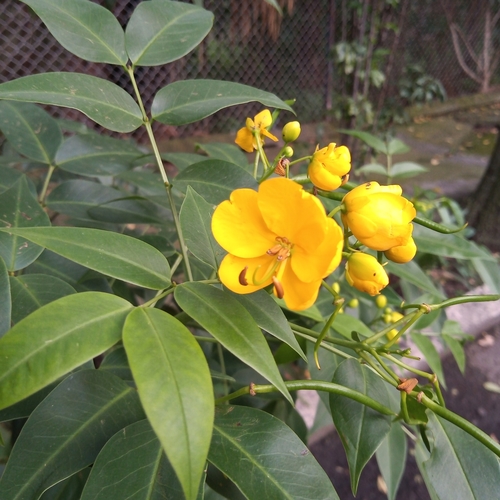
Senna septemtrionalis (Viv.) H.S.Irwin & Barneby is an erect, hairless shrub that typically reaches a maximum height of 3 meters (9.8 feet). It has pinnate leaves that measure 60 to 80 millimeters (2.4 to 3.1 inches) long in total; this measurement includes a 15 to 30 millimeter (0.59 to 1.18 inch) petiole, and the leaves hold four or five pairs of egg-shaped leaflets. Individual leaflets are 45 to 70 millimeters (1.8 to 2.8 inches) long, 15 to 28 millimeters (0.59 to 1.10 inches) wide, and are usually spaced 15 to 30 millimeters (0.59 to 1.18 inches) apart. Three or four upright, club-shaped glands grow between the lowest pairs of leaflets.
This species produces yellow flowers that grow in groups of five to eight, borne on branch ends and in upper leaf axils. Each flower cluster sits on a 30 to 40 millimeter (1.2 to 1.6 inch) peduncle, and individual flowers are attached by a 10 to 13 millimeter (0.39 to 0.51 inch) pedicel. The petals reach up to 8 millimeters (0.31 inches) long. Most flowers have seven fertile stamens, with anthers 4 to 6 millimeters (0.16 to 0.24 inches) long that vary in length, plus four sterile staminodes. In the Southern Hemisphere, flowering occurs from April to September. After flowering, the plant develops a cylindrical seed pod that is 50 to 80 millimeters (2.0 to 3.1 inches) long and 10 to 15 millimeters (0.39 to 0.59 inches) wide.
Senna septemtrionalis is native to the southern United States, Mexico, and Central America. It has been introduced to many other countries, including Queensland and New South Wales in Australia, as well as Australia's offshore islands of Lord Howe and Norfolk. In Australia, it grows in pastures and disturbed rainforest habitats.