About Acacia ligulata A.Cunn. ex Benth.
Growth Form
Acacia ligulata A.Cunn. ex Benth. grows as an erect or spreading shrub, reaching 2 to 4 metres tall and 3 metres across. It is sometimes dome-shaped, and often branches from ground level.
Bark Characteristics
The bark is typically grooved at the base, and smooth elsewhere. Its branchlets are angular, with yellowish ribs that are often covered in fine hair.
Phyllode Appearance
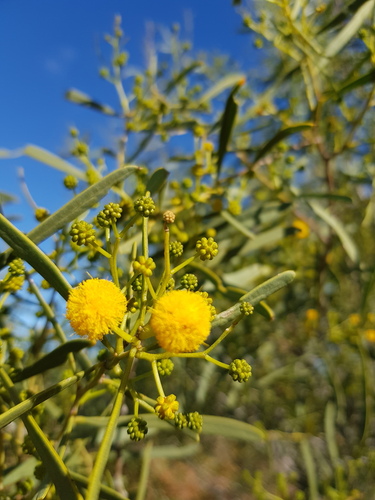
The leaf-like phyllodes are light to blue green, usually linear-oblong and slightly curved. They measure 3–10 cm long and 4–10 mm wide, are thick and hairless, and become wrinkled during dry periods.
Phyllode Vein Structure
The phyllodes have a prominent yellowish mid-vein, with no visible lateral veins. The tip of the phyllode is blunt, ending in a small hard point called a mucro that points downward.
Phyllode Gland Location
Two to four glands are located below the centre of the phyllode and near the mucro.
Flower Head Features
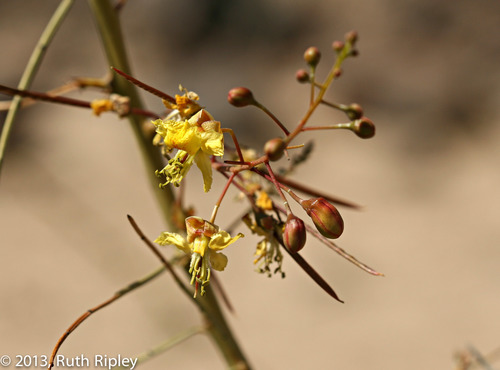
Acacia ligulata produces yellow to orange globular flower heads 5–6 mm in diameter. These flower heads grow singly or in clusters of 2 to 5 on short axillary racemes, and sit on sparsely hairy peduncles 4–10 mm long.
Individual Flower Count
Each flower head holds around 20 tiny individual flowers.
Seed Pod Characteristics
The seed pods (legumes) are light brown and curved, 5–10 cm long and 5–10 mm wide. They are constricted between individual seeds, and break easily into single-seeded segments.
Seed Pod Stalk
The stalk of the seed pod is orange to red.
Seed Features
The seeds are black, oval-shaped, and grow up to 3.5 × 3.5 mm in size, arranged lengthwise inside the pod.
Species Distribution Range
Acacia ligulata is one of the most widespread Acacia species in Australia, common across central and southern Australia. It occurs mostly south of the Tropic of Capricorn, in arid areas.
Historical Habitat Description
Explorer Charles Sturt described its habitat here in north-west New South Wales as "stupendous and almost insurmountable sand-ridges of a fiery red". This area, the Sand Plain Mulga Shrublands, supports an open cover of shrubs and tussock grasses.
Habitat Types
A. ligulata can be found growing on sand dunes, the fringes of salt lakes, floodplains, within mulga and bluebush communities, woodlands, and mallee communities. This species grows in dense shrub communities on sand dunes, and grows as scattered single plants elsewhere.
Growth Traits
It is fast-growing, stabilizes sand dunes, and regenerates quickly after disturbance such as overgrazing. Its rapid regrowth means it has potential to become weedy.
Climatic Tolerance
It grows in Australia's hottest and driest climates, with annual rainfall of less than 200 mm, and can survive light frost.
Environmental Indicators and Uses
It is an indicative species of sand plain mulga shrublands, and was used in an emissions bioassay at Olympic Dam. The roots of A. ligulata host witchetty grubs, and provide food for the larvae of the butterfly Nacaduba biocellata.
Faunal Interactions
Cattle eat the phyllodes, and rabbits often defoliate the lower portion of the plant. Kangaroos and livestock use the plants for shelter.
Regeneration Threats
Grazing by herbivores on seedlings can severely limit the species' regeneration.
Flowering Period
Acacia ligulata flowers from May to November, depending on the region, with occasional flowers produced throughout the year. Seeds develop between November and January.
Seed Dispersal Methods
Its diaspores have fleshy appendages, indicating dispersal by birds (including the red wattlebird) and ants, a process called myrmecochory. Ants can carry seeds up to 180 metres, dispersing the species across an area of 3000 m² around their nest.
Horticultural and Land Management Uses
This species is used as a hedge and windbreak, to stabilize sandy areas, for revegetation, and for erosion control, and it works well even in areas with saline or alkaline conditions. It can be grown from cuttings, and has been used as emergency stock fodder.
Traditional Pituri Preparation
Indigenous Australians used the plant by mixing its ashes with the dried, powdered leaves of Duboisia hopwoodii to create a stimulant chewing mixture called pituri, which was used for trading.
Traditional Food Uses
Gum produced by this species was eaten, and the seeds were roasted and ground to make damper.
Traditional Medicinal Uses
Leaves and bark were used for medicinal purposes, to treat colds, chest infections, and general illnesses.