About Senna notabilis (F.Muell.) Randell
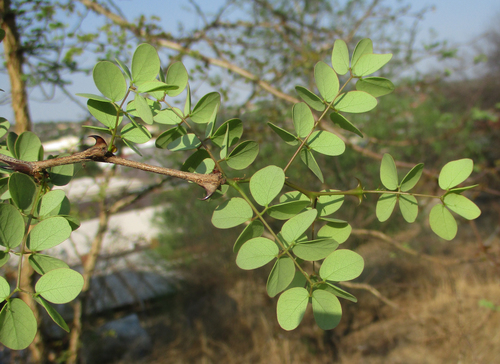
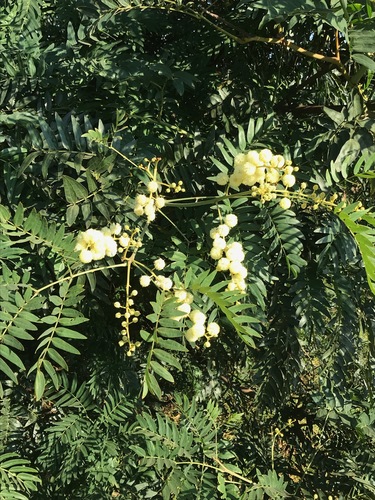
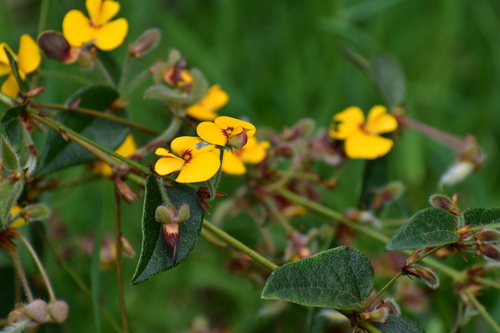
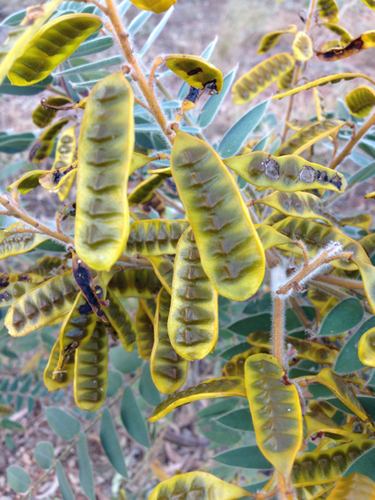
Senna notabilis is an erect, softly hairy plant that grows as an annual or perennial shrub or subshrub, typically reaching a height of 0.3 to 1.5 metres (1 foot 0 inch to 4 feet 11 inches). Its leaves grow to 100–200 mm (3.9–7.9 in) in total length, borne on a 15–20 mm (0.59–0.79 in) long petiole. Each leaf holds six to twelve pairs of lance-shaped leaflets, each 15–30 mm (0.59–1.18 in) long and 8–12 mm (0.31–0.47 in) wide, spaced 10–15 mm (0.39–0.59 in) apart. Bristly, egg-shaped stipules grow at the base of the petiole, and small glands are present between most pairs of leaflets. The yellow flowers are arranged in dense groups of twenty to thirty, growing on the ends of branches and in leaf axils. Groups are borne on a peduncle 25–60 mm (0.98–2.36 in) long, with each individual flower on a pedicel about 5 mm (0.20 in) long. The petals are about 7 mm (0.28 in) long. Each flower has seven fertile stamens and three staminodes; two anthers are about 3 mm (0.12 in) long, and the remaining anthers are shorter. Flowering takes place from May to October. The fruit is a flat pod 25–40 mm (0.98–1.57 in) long and 10–15 mm (0.39–0.59 in) wide. This species occurs in all mainland Australian states and territories except Victoria. It grows in a range of arid habitats, including rocky hillsides, clay soils, and deep desert sands, and is often found growing alongside Triodia species. It is widely distributed and common in Western Australia and the Northern Territory, with only a few collections recorded from South Australia and New South Wales.