About Senna multiglandulosa (Jacq.) H.S.Irwin & Barneby
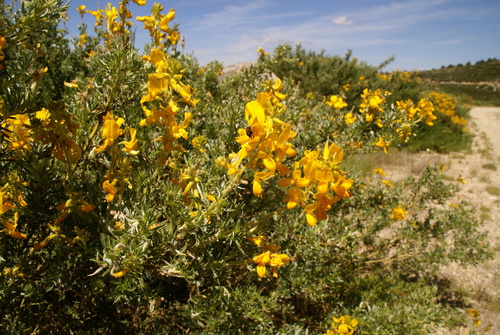
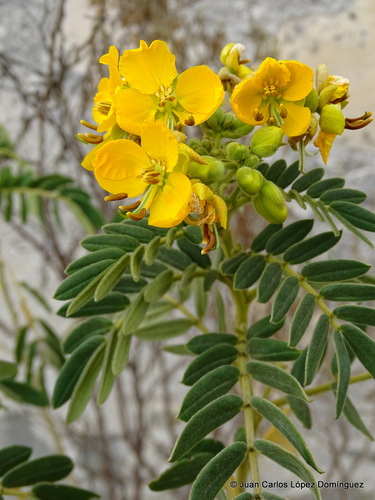
Senna multiglandulosa (Jacq.) H.S.Irwin & Barneby is a shrub that typically grows up to 4 m (13 ft) tall, and has woolly-hairy stems. Its leaves are pinnate, 60–80 mm (2.4–3.1 in) in total length, growing on an 8–12 mm (0.31–0.47 in) long petiole. Each leaf holds six to eight pairs of leaflets that are linear, lance-shaped, or oblong. Individual leaflets measure 20–40 mm (0.79–1.57 in) long, 8–12 mm (0.31–0.47 in) wide, and are spaced 8–12 mm (0.31–0.47 in) apart. Two to four glands are located between the lowest pairs of leaflets. The species produces yellow flowers, arranged in groups of ten to twenty at the ends of branchlets and in upper leaf axils. The group of flowers grows from a 20–30 mm (0.79–1.18 in) long peduncle, and each individual flower sits on a 10–12 mm (0.39–0.47 in) long pedicel. The petals are 10–20 mm (0.39–0.79 in) long. Each flower has seven fertile stamens with anthers ranging from 4 to 7 mm (0.16 to 0.28 in) in length, plus three staminodes. In Australia, flowering occurs from spring to autumn. The fruit is a cylindrical pod 60–80 mm (2.4–3.1 in) long, about 6–8 mm (0.24–0.31 in) wide, and covered in soft hairs. This species is native to Central and South America, and has been introduced to Australia, New Zealand, and New Caledonia. It is only sparingly naturalised in south-eastern South Australia, south-western Victoria, and near the eastern section of the border between Victoria and New South Wales.