About Senna didymobotrya (Fresen.) H.S.Irwin & Barneby
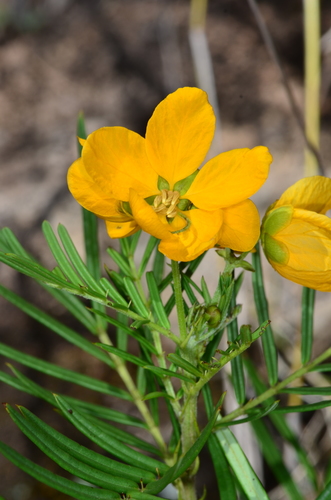
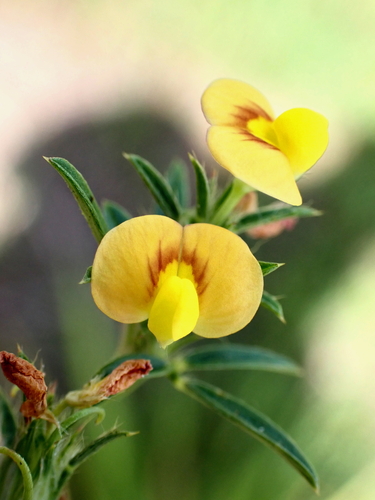
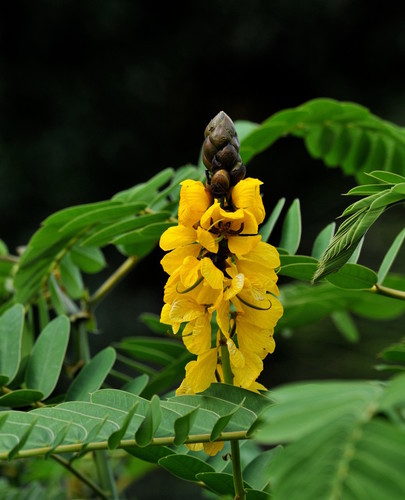
African senna, scientifically Senna didymobotrya (Fresen.) H.S.Irwin & Barneby, is a hairy, aromatic shrub. It typically grows up to around five meters tall, and can reach nine meters when grown in optimal conditions. Its leaves grow up to half a meter long, and are composed of many pairs of elongated oval leaflets, each up to 6.5 centimeters long. The plant has a strong, distinct scent that has been described as similar to mice, wet dog, peanut butter, and burnt popcorn. African senna produces abundant flowers: most grow in bright yellow racemes, while some grow in leaf axils. In a flower raceme, open flowers grow on the lower part, and unopened buds at the tip are covered in prominent brownish green or black bracts. Each flower has five concave petals, each between 1.5 and nearly 3 centimeters long. Each flower has ten stamens: most often seven fertile stamens and three sterile staminodes. Some of the stamens hold large anthers that measure one centimeter long. The fruits of African senna are flat brown legume pods, growing up to 12 centimeters long. Each pod holds up to 16 bean-like seeds, each up to one centimeter long. The plant is poisonous. In Kenya, some local cultures, especially the Kalenjin people, use African senna to prepare mursik, a special type of sour milk consumed mainly during festivities. To prepare this, a large mature plant is cut down, its branches are pruned, most of the bark is removed, and the bark is dried. After the bark is dried, and a specially made calabash gourd (called a Sotet) is cleaned and dried, the senna bark is placed in a fire and removed once charred. This process produces fragrant smoke. The charred bark is used to coat the inside of the gourd, which is then used to store either fermented or fresh milk. The plant's leaves can be squeezed to obtain an extract, which is mixed with water to make a bath that is used to treat skin infections.