About Senna acclinis (F.Muell.) Randell
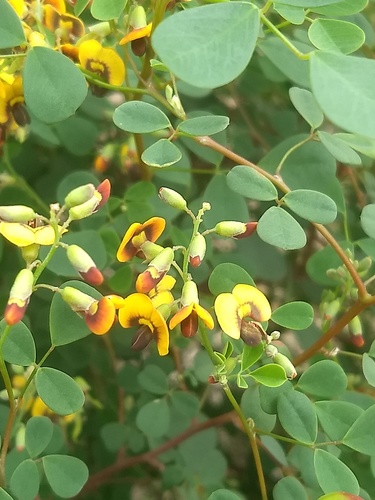
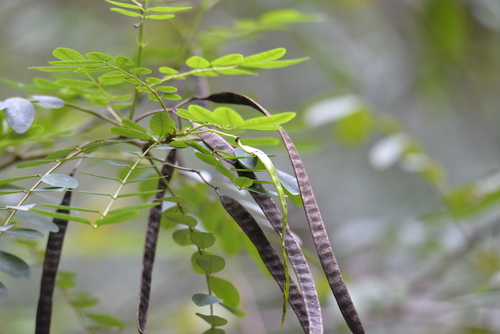
Senna acclinis is a shrub that typically grows to a height of 3 metres (9.8 feet). Its leaves are pinnate, reaching up to 150 millimetres (5.9 inches) in total length, and grow from a 20–40 millimetre (0.79–1.57 inch) long petiole. Each leaf holds five to seven pairs of broadly elliptic leaflets, which grow up to 50 millimetres (2.0 inches) long and 15 millimetres (0.59 inches) wide. A gland is present between the lowest one to four pairs of leaflets. Between two and five bright golden yellow flowers are arranged on a 20–40 millimetre (0.79–1.57 inch) long peduncle. Each flower has ten fertile stamens, whose anthers are usually of unequal lengths and measure 5–6 millimetres (0.20–0.24 inches) long. Flowering occurs in spring and summer. The fruit is a more or less flat pod that is 120–150 millimetres (4.7–5.9 inches) long and 6–8 millimetres (0.24–0.31 inches) wide, and ripens in summer and autumn. This species can be mistaken for other introduced Senna species that are classified as environmental weeds. Senna acclinis occurs in near-coastal areas of New South Wales and Queensland, where it grows in or on the edges of subtropical and dry rainforests. It has been recorded in several subregions: Barrington, Karuah Manning, Mummel Escarpment, Wyong, and Yengro. In its ecology, Senna acclinis acts as a pollination resource for several insect species. These include native bees and the jack-jumper ant Myrmecia nigrocincta, which has been recorded visiting the flowers of S. acclinis on multiple occasions. Flowers emerge during spring and summer.