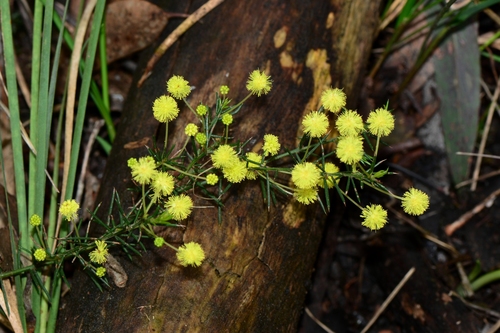
About Acacia aculeatissima J.F.Macbr.
Scientific Name
Acacia aculeatissima J.F.Macbr.
Description
Growth Habit
Acacia aculeatissima is an open, prostrate shrub. It typically grows to a maximum height of 50 cm (20 in), and rarely reaches 1 m (3 ft 3 in).
Branchlet Features
It has finely ribbed, hairy branchlets.
Phyllode Characteristics
Its phyllodes are needle-shaped, curved backwards, 5–12 mm (0.20–0.47 in) long, 0.5–1 mm (0.020–0.039 in) wide, and sharply pointed.
Flower Structure
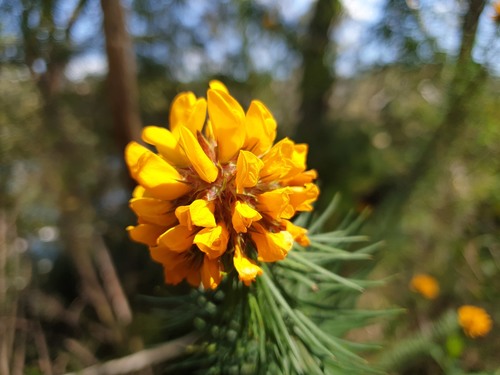
Up to 3 usually spherical flower heads are borne in the axils of phyllodes on a 5–13 mm (0.20–0.51 in) long peduncle; each flower head holds 15 to 25 pale yellow to yellow flowers.
Flowering Period
Flowering occurs between August and November.
Seed Pod and Seeds
The seed pod is straight or slightly curved, papery, 30–60 mm (1.2–2.4 in) long and 2–4 mm (0.079–0.157 in) wide, and contains oblong seeds 3.5–4.0 mm (0.14–0.16 in) long.
Distribution and habitat
Preferred Growing Conditions
This wattle species grows most often in rocky areas within woodland, forest and heath, in soils formed from sedimentary rocks.
Geographical Range
It occurs south from Mount Imlay in New South Wales, and in southern Victoria, where it is more common.