About Senegalia greggii (A.Gray) Britton & Rose
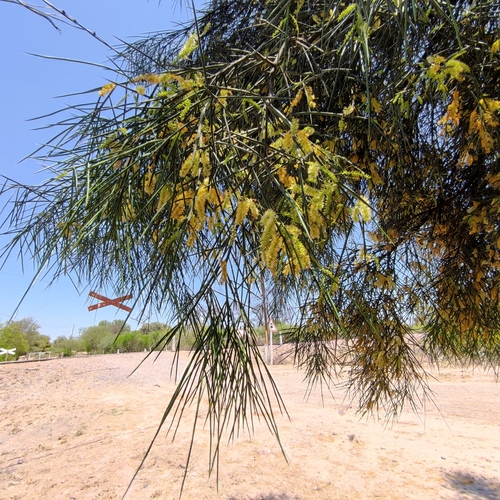
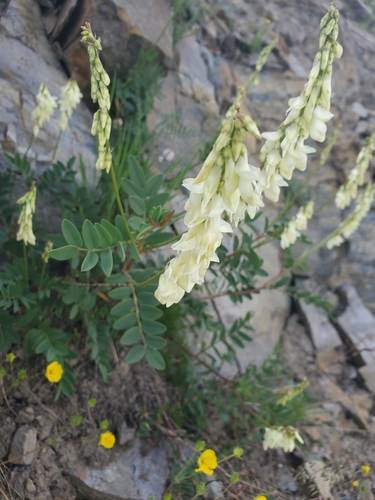
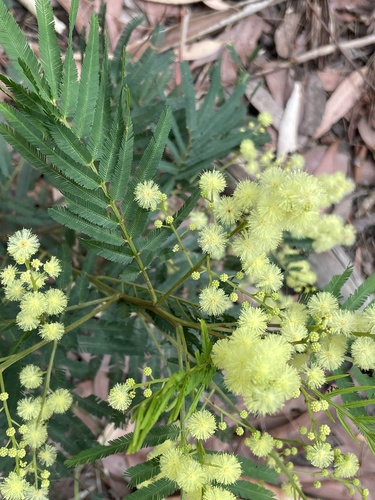
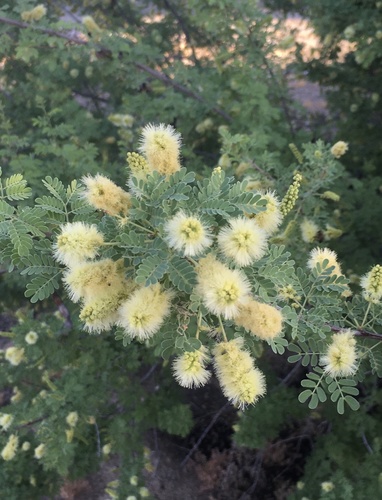
Senegalia greggii (A.Gray) Britton & Rose is a large shrub or small tree, reaching 10–15 m (33–49 ft) tall, with a trunk that grows up to 20–30 cm (7.9–11.8 in) in diameter. Its grey-green leaves are deciduous and bipinnate, divided into 1–3 pairs of pinnae. Each pinna is 2–3 cm (0.79–1.18 in) long, and holds 10–18 leaflets that measure 3–6 mm (0.12–0.24 in). Pinnae most often occur in two pairs: the proximal pair sits perpendicular to the petiolule, and the distal pair forms a V at the tip. Blooms form dense cylindrical spikes containing many individual flowers. Each flower has five cream-colored 3 mm (0.12 in) petals and numerous creamy yellow 6 mm (0.24 in) stamens. The fruit is a flat, twisted legume pod 6–15 cm (2.4–5.9 in) long, which generally holds 3 to 5 hard, flattened, medium brown seeds. The seed pod is constricted between seeds, a structure called a loment, and seed dispersal happens both through dehiscence and breaks at these constrictions.
Senegalia greggii is most common in arroyos, where its roots can access deep water. Its seeds require physical scarification to germinate, which effectively prevents germination unless a flash flood disturbs the area and deposits enough water to increase the chance that seedlings will grow deep enough roots to survive the dry season. This species, commonly called catclaw, is fully drought deciduous and usually lacks leaves for most of the year. S. greggii has extrafloral nectaries, a trait shared with other senegalias. A tentative connection between these glands and insects suggests a mutualistic relationship, similar to what is seen in other Senegalia species. Ants are known to use the glands as a source of food and water, and may provide the plant with some defense against herbivorous insects. Like other arroyo trees in the family Fabaceae, S. greggii is frequently infected by Desert Mistletoe, Phoradendron californicum. Unlike other legumes, S. greggii is not known to form root nodule associations with nitrogen-fixing bacteria.
It has been proposed that this species may be an example of an evolutionary anachronism, where the species' range and renewal are limited because of the extinction of the mammalian megafauna that originally dispersed its seeds. Under this model, the scarification required for seed germination would have occurred while large mammals chewed and digested the fruit, later excreting the intact seeds some distance away from the parent tree. Gambel quail eat the seeds of this species, and antelope browse its foliage; more delicate species may browse cautiously due to the plant's thorns.