About Senecio quadridentatus Labill.
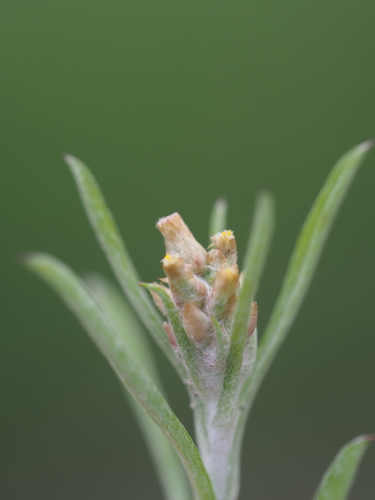
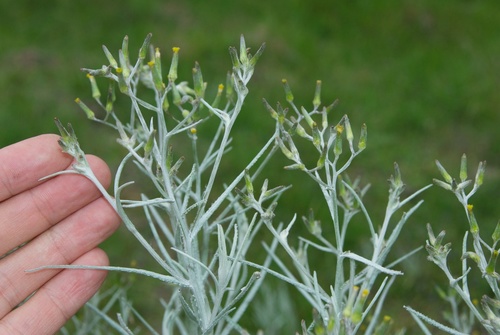
Senecio quadridentatus Labill., commonly known as cotton fireweed, is an erect annual or short-lived perennial herb that grows up to around 1 meter tall. From a distance, it generally appears silver-toned and is considered attractive. Its stems branch from or near the hard woody base, and are covered in thick, fine white hair-like filaments that thin out as the plant ages. Lower and middle stem leaves are evenly arranged and similar in size, measuring 4–12 cm long and 1.5–6 mm wide. These leaves are linear to narrow lance-shaped with pointed tips and are nearly stalkless. The upper leaf surface is grey-green, covered in white woolly hairs or hairless, while the lower surface has moderate to dense white woolly hairs. Leaf margins are mostly smooth, or sometimes have widely spaced teeth, and are rolled inward almost to the midrib. Upper stem leaves are smaller with smooth margins, and may be slightly stem-clasping. Basal leaves are typically wider and relatively flattened. The inflorescence forms a loose umbellate panicle at the tips of the branches. At the base of each flowerhead, there are 3–5 supplementary bracts 1–1.5 mm long, and 12–13 involucral bracts 6–9 mm long. The involucral bracts are narrow linear-lanceolate toward their sharp tip, are dry and membranous, and are hairless or have very fine hairs along their margins. The entire involucre (flower base) is slender and narrowly cylindrical. The yellow flowerhead contains around 30 disc florets and no ray florets, and measures about 2 mm in diameter. Some florets are female, thread-like, with 3–4 teeth, and measure around 6 mm long. The remaining florets are bisexual and tubular, with 4–5 teeth, and become slightly thickened at the tip. The fruit of Senecio quadridentatus is an achene, a dry, single-seeded, non-opening fruit with the seed distinct from the fruit wall, which is characteristic of all plants in the composite family. The achenes of S. quadridentatus are narrow columnar, slightly curved, and narrow suddenly near the apex. They have narrow grooves with sparse hairs between flattened ribs, and measure around 3 mm long. The pappus is made of white feathery bristles, and measures 5–6 mm long. Cotton fireweed is an invasive weed that is unpalatable and poisonous to livestock. Cotton fireweed is native to New Zealand, where it occurs on the North Island, South Island, and multiple offshore islands including Three Kings, Stewart Island, and Chatham Island. It is also found in Australia, Tasmania, Timor, and Indonesia. Cotton fireweed grows mainly in rough, rocky sites such as riverbeds, rock outcrops, cliffs, and waste areas, and occurs sporadically in shrubland and grassland. It prefers open habitats, growing from lowland to mountain elevations up to 1000 m above sea level. Unlike other fireweeds, it cannot grow in areas with a thick canopy, as it requires adequate light. It is consistently found in areas that have experienced recent disturbance. It may emerge rapidly in new pastures, then disappear after several years. It often increases in abundance on fertilized land treated with superphosphate, lime, or gypsum. A population found in an urban area of Christchurch, New Zealand, is thought to have established from wind-dispersed seeds originating from nearby Port Hill. Senecio quadridentatus is a short-lived plant that can grow as an annual or short-lived perennial. It is primarily a short-lived perennial that can resprout after disturbance, but will grow as an annual under harsher growing conditions. Its flowering period runs from October to March, and its fruiting period runs from December to May. Flowering and fruiting times vary considerably across different regions. Seeds are dispersed by wind, aided by the pappus attached to each achene. Seeds can remain dormant in soil for a couple of years, and germinate quickly after summer heat, fire, or other disturbances.