About Senecio brasiliensis (Spreng.) Less.
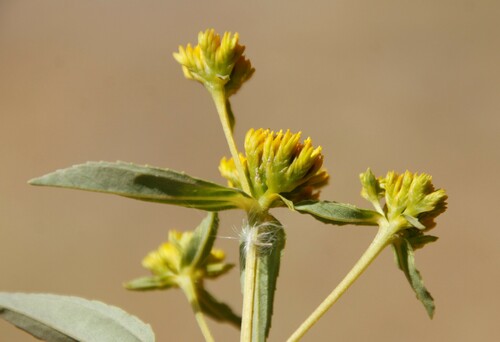
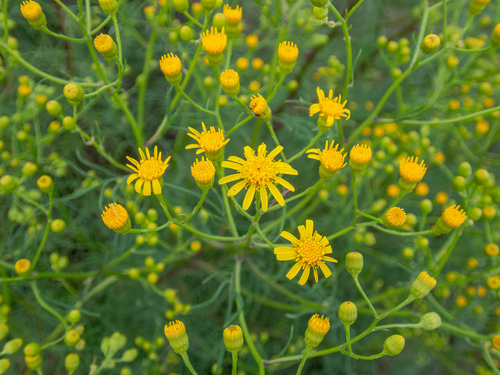
Senecio brasiliensis (Spreng.) Less. is a densely leafy perennial herb that grows 1 to 2 meters (3.3 to 6.6 feet) tall, and produces yellow flowers. It typically grows in degraded pasture lands and unploughed croplands in central South America. This species has an upright growth habit, with a branched, hairless, grooved stem. Its leaves are arranged alternately, are pinnate and deeply lobed. The upper leaf surface is dark green, while the lower leaf surface is whitish green. The lower portion of the plant is smooth, while the upper portion is hairy. Leaves cluster at the top of the plant alongside the flower stalks, called corymbs. Yellow flowers grow densely on these corymbs. There are two types of flower structures that resemble petals: disc florets, which contain both male and female reproductive parts, and ray flowers, which are only female. Its seeds are small, attached to white hairs that allow them to disperse via wind. It grows at elevations from 0 to 1,000 meters (3,300 feet). It is native to Argentina (most commonly in North Argentine Northwest and Gran Chaco), Bolivia, Brazil (most commonly in South Central Brazil), Paraguay, and Uruguay. It is currently also found in: North America (Alabama and Florida in the United States of America), the same South American native range, and south-western Europe (Portugal).