About Selinum carvifolia (L.) L.
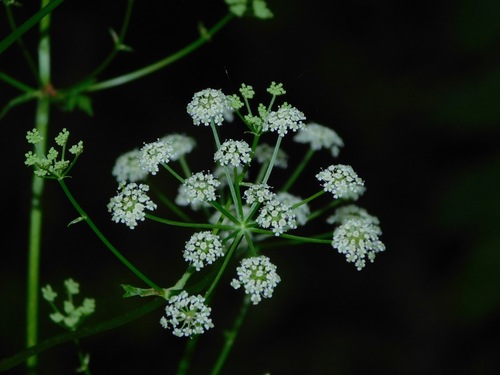
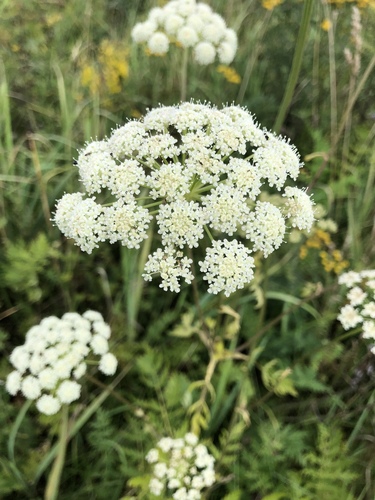
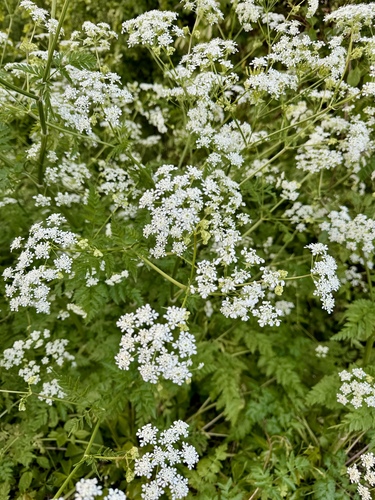
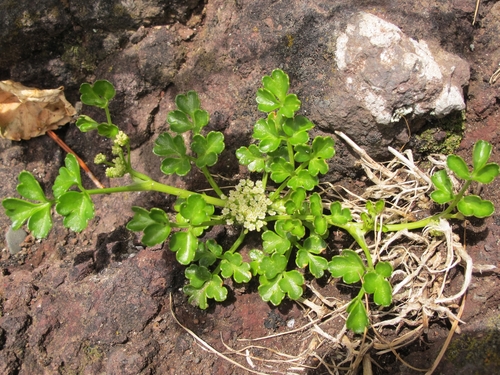
Selinum carvifolia (L.) L. is a flowering plant in the genus Selinum of the family Apiaceae. Its specific epithet carvifolia means "having leaves resembling those of caraway".
This species grows in fens and damp meadows, with a native range that covers most of Europe (excluding much of the Mediterranean region) and extends east through Central Asia to West Siberia and Kazakhstan. It is naturalized in the United States, where its common name is little-leaf angelica.
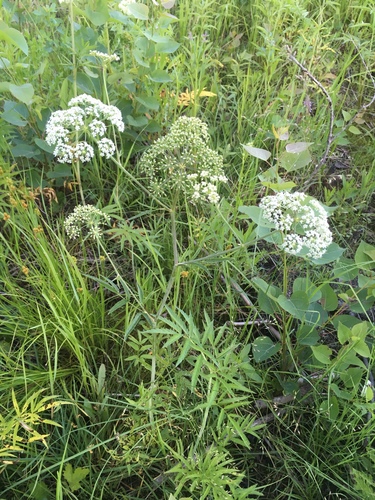
Its English common name is Cambridge milk parsley. In the United Kingdom, it is currently only found in Cambridgeshire, growing as a lowland perennial herb in fens, damp meadows, and rough-grazed marshy pasture on calcareous peaty soils or fen peat over chalk. It does not grow on the wettest fen ground, instead preferring slightly better-drained fringe areas and low banks. It used to grow in the English counties of Nottinghamshire and Lincolnshire, but is now extinct in both. Today it grows only in three small Cambridgeshire fens, making it one of England's rarest umbellifers. Across continental Europe, it has been recorded in a much wider range of habitats, including Polish oakwoods and hot dry limestone in Bosnia and Croatia.
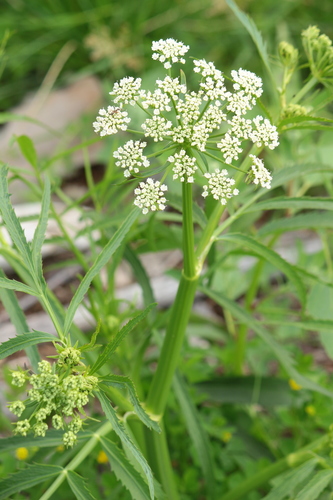
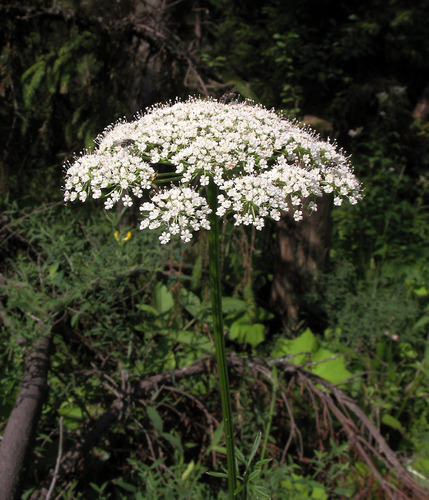
Cambridge milk parsley is closely related in appearance and habitat to Peucedanum palustre (milk parsley), a different umbellifer genus that shares the same moist habitats. The two species can be distinguished by several features. P. palustre has hollow, often purplish stems, pinnatifid leaf lobes, and deflexed bracteoles; S. carvifolia has solid, greenish stems, entire or sometimes lobed leaf lobes, and erecto-patent bracteoles. When fruiting, S. carvifolia fruits have three winged dorsal ridges, while the dorsal ridges of P. palustre fruits are not winged. Leaflet tips also differ: P. palustre leaflets have blunt, pale tips, while S. carvifolia leaflets have sharply pointed, darker green tips.
When crushed, Selinum carvifolia has a mild parsley-like scent, but unlike the caraway its specific name references, it is not a highly aromatic umbellifer. There are few recorded uses of the plant as food, seasoning, or medicine, and it is not listed as a poisonous plant.