About Selasphorus calliope (Gould, 1847)
Common Name and Status
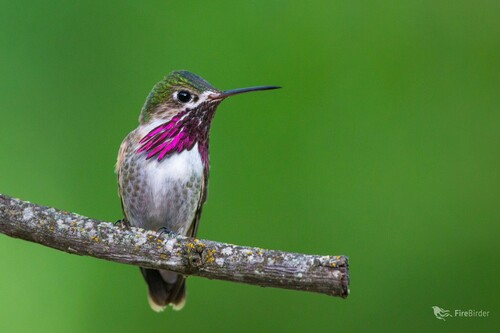
Selasphorus calliope, commonly known as the calliope hummingbird, is the smallest bird that breeds in Canada and the United States.
Adult Size Measurements
Adult calliope hummingbirds measure 7–10 cm (2.8–3.9 in) in length, have a wingspan of 11 cm (4.3 in), and weigh between 2 and 3 g (0.071 to 0.106 oz).
General Plumage
This species has glossy green plumage on the back and crown, with white underparts.
Adult Male Plumage
Adult males have wine-red streaks on the gorget, green flanks, and a dark tail.
Male Courtship Display Feature
When competing for territory or mates, the male’s dark red gorget feathers distend outward to create a more noticeable appearance.
Female and Immature Plumage
Females and immature calliope hummingbirds have a pinkish wash on the flanks, dark streaks on the throat, and a dark tail with white tips.
Similar Species Distinction
The species most similar to the calliope hummingbird are the rufous hummingbird and Allen's hummingbird; both are larger, have more distinct contrasting rufous markings on the tail and flanks, and longer central tail feathers.
Breeding Habitat Type
The calliope hummingbird's breeding habitat occurs across a variety of open shrub habitats at a wide range of altitudes.
Nesting Elevation Range
Nesting most often takes place at higher elevations in the Rocky Mountains. Nests have been recorded at elevations from as low as 180 m (600 ft) in Oregon and Washington up to the tree line at over 3,400 m (11,000 ft).
Regional Breeding Elevation
In Montana, the lowest recorded elevation for breeding is 1,200 m (3,900 ft).
Breeding Ground Vegetation
Breeding grounds can include open montane forest, mountain meadows, and willow and alder thickets.
Non-breeding Habitat
During migration and winter, calliope hummingbirds can also be found in chaparral, lowland brushy areas, deserts, and semi-desert regions.
Breeding Range
They breed in western North America, ranging from southern British Columbia and Alberta south to Colorado and southern California.
Winter Migration and Range
In winter, they migrate primarily through Arizona, New Mexico, and northern Mexico to reach their wintering range in southwestern Mexico.