About Scutellaria montana Chapm.
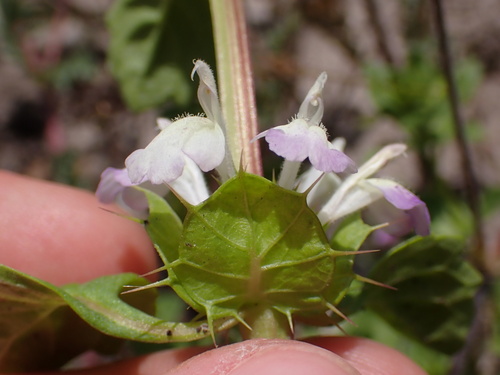
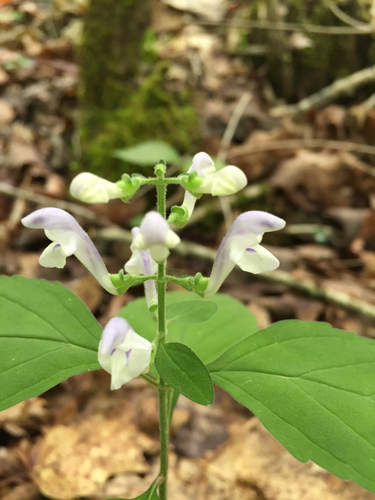
Scutellaria montana Chapm. produces a single, erect, square stem, and reaches a mature height between 30 and 60 centimeters. Its leaves are simple, arranged oppositely along the stem, with shapes ranging from lanceolate to ovate, and margins that are crenate to serrate. Leaf blades measure 5 to 8 centimeters long and 3 to 5 centimeters wide. A defining trait of this species is soft leaf pubescence, made up of both glandular and non-glandular hairs that cover both leaf surfaces. As the common name largeflower skullcap implies, its inflorescences hold large flowers that are 2.6 to 3.5 centimeters long. Flowers grow at the tip of the stem and are blue and white. A key identifying feature that separates this species from other members of the Scutellaria genus is the absence of an annulus within the corolla tube, near the top of the calyx. It is the only species in Scutellaria Section Annulatae that lacks an annulus. This species blooms from mid-May to June, and its fruits mature in June and early July. It inhabits mid- to late-successional forests dominated by oak and pine trees, most commonly Quercus alba, Q. velutina, Q. montana, Pinus echinata, and/or P. taeda. Its habitat has acidic, rocky, shallow soil, which can be as little as 3 centimeters deep, and conditions range from dry to somewhat moist. Associated understory and canopy plants in its native habitat include Desmodium species, Hexastylis species, Chimaphila maculata, and Cornus florida. Scutellaria montana was first federally listed as an endangered species in 1986. After additional populations were discovered, it was downlisted to threatened status in 2002. It remains threatened by human activities including logging, suburban development, and quarrying.