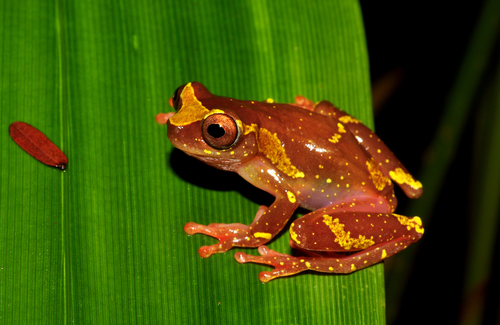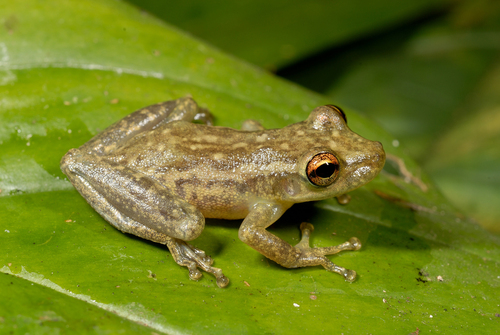
About Scinax ruber (Laurenti, 1768)
Adult Snout-Vent Length
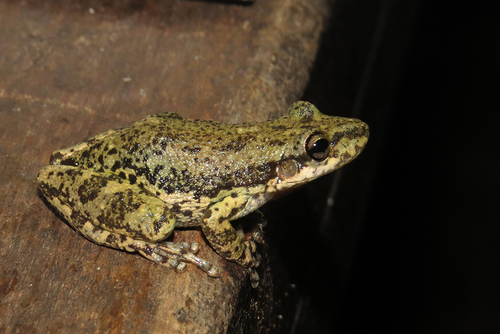
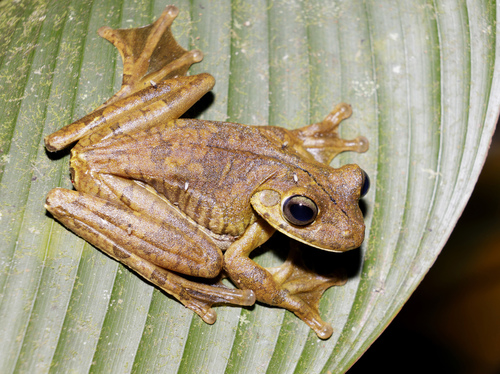
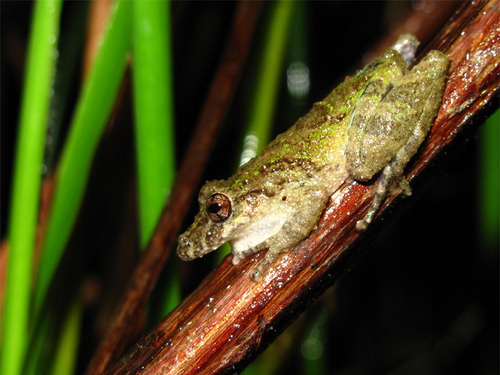
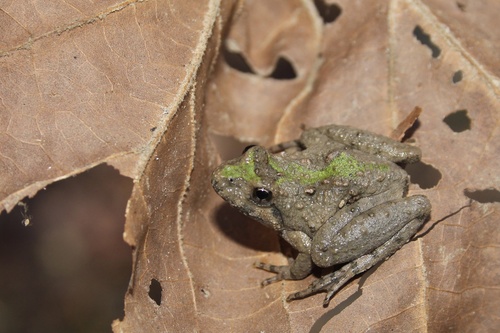
Adult male Scinax ruber measure 29–41 mm (1.1–1.6 in) and adult females measure 37–44 mm (1.5–1.7 in) in snout–vent length.
Head Morphology
This species has a rounded, non-acuminate snout, and a distinct tympanum.
Dorsal Skin Texture
Dorsal skin ranges from smooth to finely tuberculate.
Dorsal Coloration and Markings
The dorsum is tan to dull green, and usually features a wide creamy tan to yellow dorsolateral stripe with dark borders that extends from the eyelid to the sacrum. A discontinuous tan middorsal marking is also usually present.
Flank Markings
The flanks are cream with yellow spots, which are usually edged with black in the groin.
Limb Coloration
The posterior surfaces of the thighs are brown, mottled with yellow or orange.
Iris and Venter Coloration
The iris is bronze with black reticulations, and the venter is yellow.
Native South American Range
Scinax ruber is widespread across South America from sea level to around 2,600 metres, occurring throughout the Amazon Basin and the Guiana Shield in Brazil, Colombia, Ecuador, French Guiana, Guyana, Peru, Suriname, and Venezuela.
Native Panama and Caribbean Island Range
It is also found in central Panama and the eastern lowlands of Darien Province, Panama, as well as on Trinidad and Tobago.
Introduced Range and Invasive Status
It has been introduced to Martinique, Puerto Rico, and Saint Lucia; it is considered an invasive species on Martinique, where it threatens native frogs.
Habitat Range and Elevation
This species is abundant in temporary waterbodies during the rainy season, and occupies a wide range of habitats: from open environments to moist forests, as well as gardens and parks, ranging from sea level to 2,600 m (8,500 ft) above sea level.
Behavior and Breeding
It is a nocturnal and arboreal species that generally breeds in small temporary pools, but can also use roadside ditches.
Conservation Status
This common and widespread species faces no major threats, is classified as "Least Concern" by the IUCN, is highly adaptable, and occurs in many protected areas.