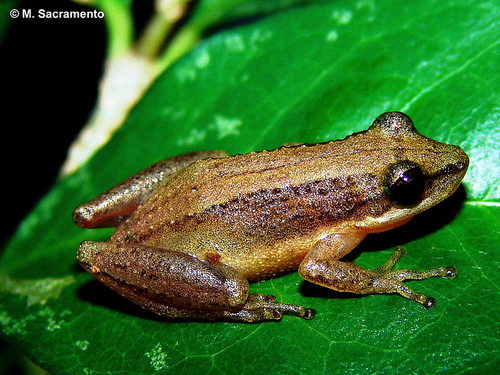
About Scinax fuscomarginatus (Lutz, 1925)
Male Size
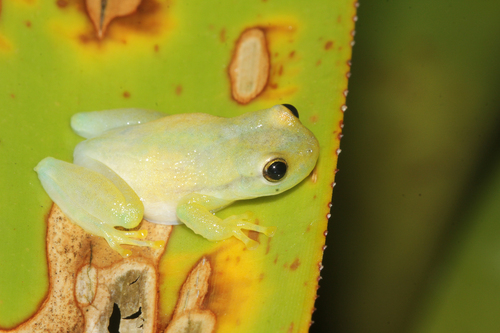
Description: Adult males of Scinax fuscomarginatus measure 16–27 mm (0.6–1.1 in) in snout–vent length.
Head Structure
The snout is subelliptical when viewed from above, and the head is longer than it is wide. The tympanum is small, not very distinct, and its upper portion is hidden by the supra-tympanic fold.
Limb Morphology
The short fingers have elliptical discs and reduced webbing. The slender toes also have elliptical discs; their degree of webbing varies, but is more developed than the webbing on the fingers.
Dorsal Coloration
In preservative, the dorsum is light brown with a pattern of brown dorso-lateral stripes, combined with a median line and an inter-ocular stripe. This pattern varies greatly between individual frogs.
Ventral Coloration
The chest and belly are either immaculate or have fine small spots.
Male Vocal Sac
Males have a large, subgular vocal sac.
Advertisement Call
The male advertisement call is a single multi-pulsed note with modulated frequency. The note lasts 0.3–0.9 seconds, and the dominant frequency is around 3780 Hz, with a range of 2960–4590 Hz.
Habitat Range
Habitat and conservation: Scinax fuscomarginatus lives in open habitats of the Pantanal, Cerrado, Humid Chaco, Beni savanna, and Chiquitano dry forests, as well as in open habitat enclaves within the Atlantic and Amazon forests.
Elevation Range
It occurs at elevations up to at least 1,000 m (3,300 ft) above sea level.
IUCN Assessment Context
The 2004 IUCN assessment of this species predates a major taxonomic revision that resulted in recognizing the species as more widely distributed than previously understood.
Conservation Threats
At the time the IUCN assessment was completed, no major threats to this species could be identified.