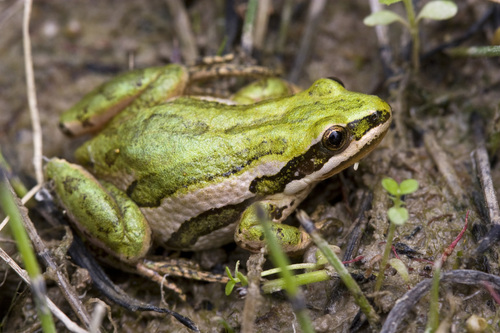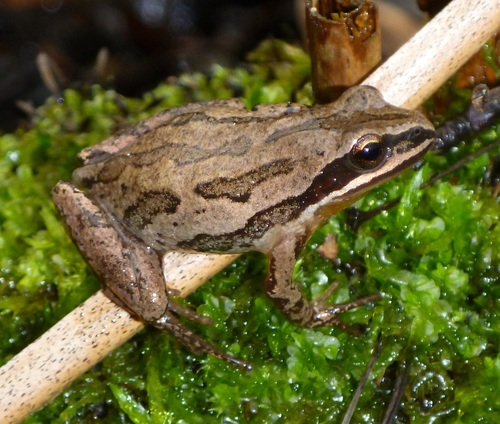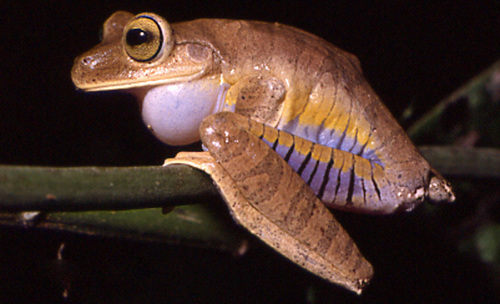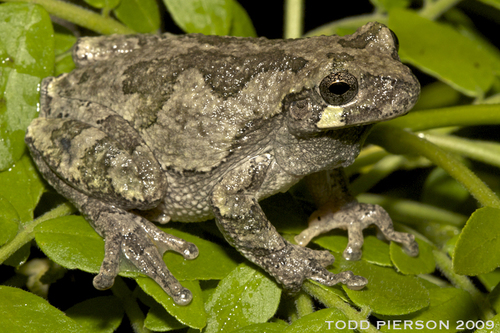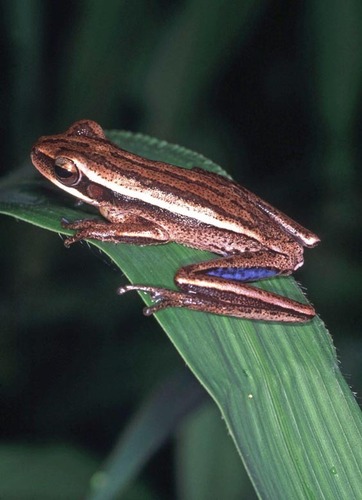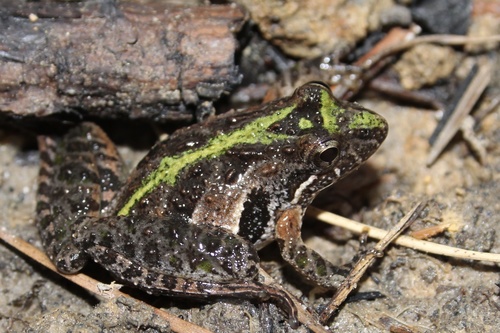
About Acris gryllus (LeConte, 1825)
Taxonomy and Size
Acris gryllus, described by LeConte in 1825, measures 0.75–1.5 inches (16–32 mm) in total length, making it even smaller than the related species Acris crepitans.
Snout Morphology
It can be differentiated from A. crepitans by several key physical traits: it has a more pointed snout, while A. crepitans has a blunter snout.
Folded Hind Leg Length
When folded, the hind leg of A. gryllus is more than half the length of its body, whereas the folded hind leg of A. crepitans is less than half its body length.
Extended Hind Leg Position
When the hind leg is extended forward, the heel of A. gryllus usually extends past the snout, while the heel does not reach the snout in A. crepitans.
Jumping Ability
A. gryllus is capable of jumping longer distances than A. crepitans.
Thigh Stripe Pattern
It has a sharply defined black stripe along the back of the thigh, while A. crepitans has a ragged thigh stripe.
Rear Foot Webbing
The webbing on the rear feet of A. gryllus is sparse, while it is more extensive on the rear feet of A. crepitans.
Vertebral Stripe Variability
There is evidence that the color of the vertebral stripe on southern cricket frogs can vary over time, and can change within a single frog's lifetime.
General Habitat
In terms of range and habitat, the southern cricket frog is typically found in coastal plain bogs, bottomland swamps, ponds, and ditches.
Habitat Preference
It prefers open, sunny areas, and is usually not found in woodlands.
Acris gryllus gryllus Range
The subspecies Acris gryllus gryllus occurs in the Atlantic Coastal Plain from southeastern Virginia, through North Carolina, South Carolina, Georgia, Alabama, and Mississippi, extending west to the Mississippi River.
Acris gryllus gryllus Elevational Range
It is found mostly east of the Fall Line, but reaches into more upland areas of the Piedmont along river valleys.
Acris gryllus dorsalis Range
The subspecies Acris gryllus dorsalis occurs across the entire Florida peninsula.
Breeding Period
For reproduction, breeding takes place in late spring and summer.
Male Advertisement Call
Males produce an advertisement call that sounds like a loud, rapid gick, gick, gick.
Female Reproductive Output
Females lay up to 150 eggs at a time, and may produce more than one egg mass in a single breeding season (Martof et al. 1980).