About Schizolobium parahyba (Vell.) S.F.Blake
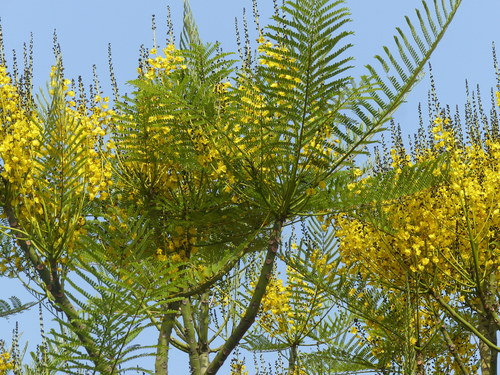
Mature Schizolobium parahyba trees typically have a straight trunk reaching up to 40 meters in height and 80 centimeters in width, with branching occurring only near the top of the trunk. The bark is smooth and gray-green, with the only exceptions being the scars left by fallen leaves. Its leaves are bipinnate, measure one meter or more in length, and grow from a green stem. Each leaf holds 30–50 opposite pinnae; each pinna in turn holds 40–60 leaflets that are 2–3 centimeters long. The leaves cluster near the ends of branches, and fall off completely during the dry season. Young Schizolobium parahyba specimens are often unbranched, and have leaves over 2 meters long, so they are frequently mistaken for ferns or palms. A large pulvinus is present at the base of each leaf. This species produces numerous bright yellow, nectar-producing flowers that are approximately 3.5 centimeters in diameter. The flowers bloom from October through December in the Southern Hemisphere, after the tree’s leaves have already fallen. In Southeast Brazil, the flowers are primarily visited by the bee species Centris labrosa, Centris varia, Xylocopa frontalis, and species from the genus Megachille. Fruits ripen between April and June. Each fruit is a tadpole-shaped pod around 10 centimeters long, holding a single smooth, brown, oval seed. The wood of Schizolobium parahyba is odorless, straw-colored, soft, and lightweight, with a density ranging from 0.32 to 0.39 g/cm3 that increases as the tree ages. It was historically used to make dugout canoes, and is currently used for toys, boxes, shoe heels, the inner layers of laminated wood, and paper. This tree grows easily in cultivation, and can produce 600 cubic meters of wood per hectare after 10 years of growth. The leaves contain water-soluble substances that act as antidotes to bites from Bothrops snakes. The seeds are traditionally used to make beads and buttons.