About Sceloporus occidentalis Baird & Girard, 1852
Scientific Name and Common Name
Sceloporus occidentalis Baird & Girard, 1852, commonly called the western fence lizard, has a snout-vent length of 5.7–8.9 cm (2.2–3.5 inches) and a total length of around 21 cm (8.3 inches).
Size
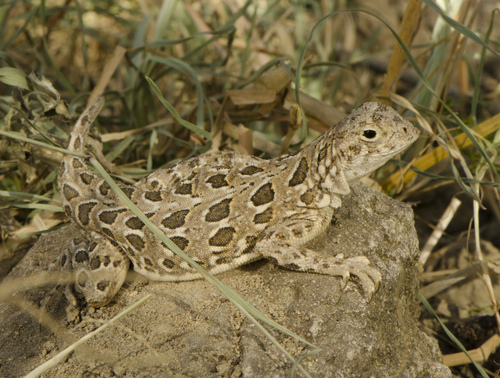
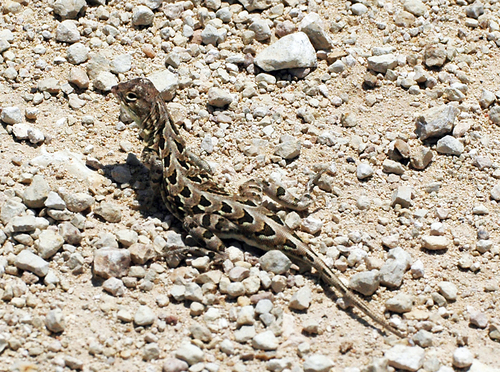
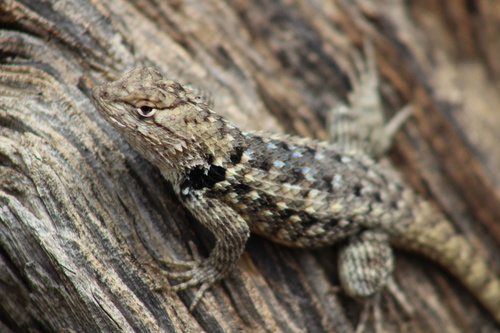
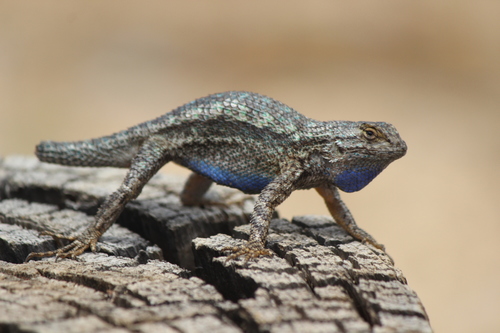
Their base color ranges from brown to black; the brown shade can be sandy or greenish, and they have black stripes along their backs.
Dorsal Coloration
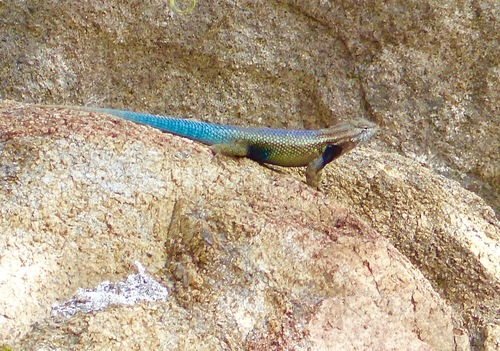
Their most distinctive feature is their bright blue bellies, with yellow coloring on the ventral sides of the limbs.
Ventral Coloration
Males also have blue patches on the throat, but this bright blue coloration is faint or completely absent in females and juveniles.
Sexual and Juvenile Color Dimorphism
In some populations, males additionally show iridescent, bright turquoise blue spots on their dorsal surface.
Male Dorsal Ornamentation
The species has sharply keeled scales, with 35–57 scales counted between the interparietal scale and the rear of the thighs.
Scale Characteristics
A number of other lizard species have similar bright blue coloring, and can be distinguished from this species: the eastern fence lizard (Sceloporus undulatus) has two small throat patches instead of one large patch; the sagebrush lizard (Sceloporus graciosus) lacks yellow ventral limb coloring and has smaller dorsal scales; the side-blotched lizard (Uta stansburiana), which also resembles S. occidentalis, usually has a black spot behind its axilla and has a complete gular fold.
Similar Species Distinction
While California forms the core of this species' range, it is also found in eastern and southwestern Oregon, with some populations occurring even north of Seattle, Washington.
Core Range
Additional distribution areas include the Columbia River Gorge, southwestern Idaho, Nevada, western Utah, northwestern Baja California, New Mexico, Arizona, and several islands off the coasts of both California and Baja California.
Wider Distribution
There is also an isolated population in the northwestern Tualatin Valley, near Henry Hagg Lake.
Isolated Population
The western fence lizard lives in a wide range of habitat types: grassland, broken chaparral, sagebrush, woodland, coniferous forest, and farmland.
Habitat Types
It occupies elevations from sea level up to 10,800 ft, generally avoids harsh desert environments, and is most often found near water.
Elevation and Habitat Preferences
Across California, the lizard occurs in most areas outside of deserts and densely forested locations.
California Distribution
Predictions from the California Department of Fish and Wildlife indicate that most of California, with the exception of the San Joaquin Valley and southeastern California, provides suitable habitat for the species.
Suitable Habitat Predictions
In its native habitats, the western fence lizard is an important food source for many vertebrates, including snakes and predatory birds.
Ecological Role
Currently, the species is listed as unprotected, with no conservation restrictions applied to it.
Conservation Status
Western fence lizards mate in spring, and do not reach breeding age until the spring of their second year.
Breeding Age and Mating Season
Courtship for captive individuals occurs in March and April, with copulation taking place in May and June.
Courtship and Copulation Timing
There is an interval of approximately two weeks to one month between copulation and egg laying.
Egg Laying Interval
Females dig nests at night under flat surfaces to lay their eggs.
Nesting Behavior
Between April and July, a female will lay one to three clutches, each containing 3 to 17 eggs (most commonly 8 eggs total per clutch).
Clutch Characteristics
Eggs hatch after an incubation period of around 60 days.