About Scarus vetula Bloch & Schneider, 1801
Adult Physical Traits
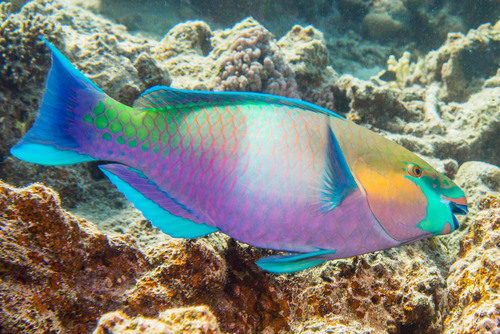
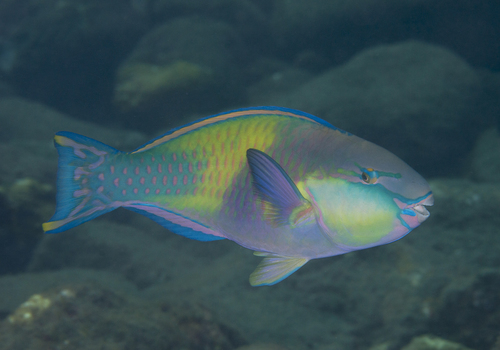
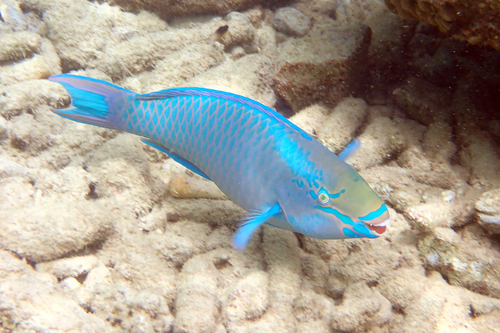
The adult queen parrotfish (Scarus vetula Bloch & Schneider, 1801) is a heavy-bodied fish with a spindle-shaped (fusiform) body and a beak-like mouth, reaching an approximate length of 60 cm (24 in). This species is a protogynous hermaphrodite, meaning it has the ability to change sex, and also displays sexual dichromatism.
Life Phases
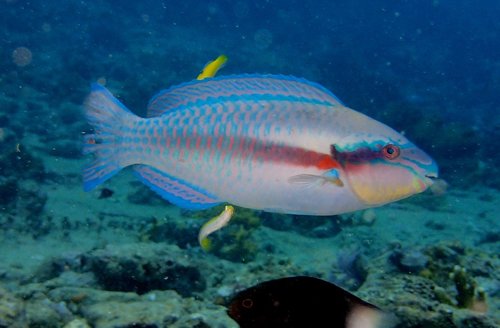
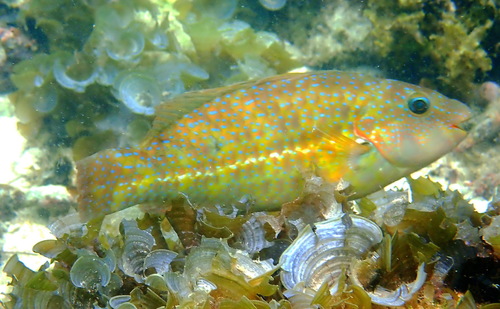
Three distinct life phases have been identified, each with unique coloration corresponding to its maturity stage: juvenile (JU: fork length less than 15 cm), initial phase (IP: 15 to 35 cm FL), and terminal phase (TP: 28 to 50 cm FL). All initial phase individuals are female, and are colored reddish-brown or grayish-brown with a paler head and a white lateral stripe low on each flank; this coloration remains consistent even as they grow larger.
Sex Change and Terminal Phase Coloration
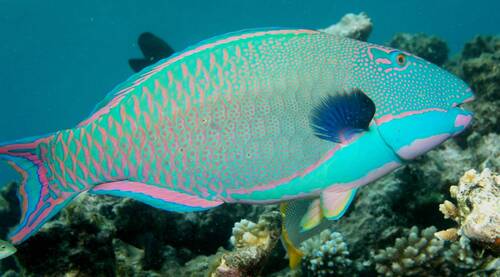
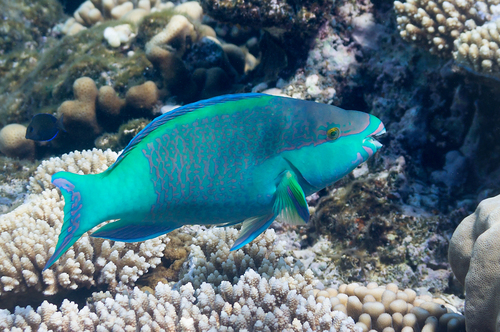
At an average length of 25 cm (10 in), females change sex to become males. Larger terminal-phase males develop a new coloration: they become pale bluish-green, with blue spots near the mouth, yellowish streaks between the mouth and eye, and pale blue bars on the pectoral fins.
Native Range
Queen parrotfish is native to the tropical West Atlantic Ocean, the Caribbean Sea, and the southern Gulf of Mexico. It inhabits both rocky and coral reefs at depths down to approximately 25 m (80 ft).
Feeding Habits
It feeds primarily on algal turf scraped off surfaces and coral from coral reefs, and may also consume sponges and other encrusting organisms while feeding. As a member of the Scarus genus, all species share the same feeding mode, which differs from the Sparisoma genus, which uses three distinct feeding modes.
Sediment Deposition
While feeding, the queen parrotfish swallows large amounts of mineral particles, which are later deposited as fine sand on the seabed. The rate of sediment deposition across reefs varies depending on parrotfish species and body size.
Nocturnal Behavior
It is a diurnal fish; at night, it rests on the seabed or hides in a crevice, surrounded by a layer of mucus it exudes that may help hide it from predators. This mucus forms a cocoon made of a complex disulfide-bonded network of glycoproteins.
Predators
This protection is critical because queen parrotfish are preyed on by a range of predators including sharks, groupers, and eels.
Reef Ecological Functions
Based on their feeding modes, parrotfishes provide multiple functions on reefs: scraping, excavating, and browsing. These functions come from differences in jaw morphology that allow different amounts of substrate to be removed.
Species Feeding Comparison
For example, the stoplight parrotfish (Sparisoma viride) is an "excavator" that degrades the surface of coral colonies, while Scarus vetula is a "scraper" that erodes carbonate materials from corals, but to a lesser degree than S. viride. Studies have found that S. vetula has a higher bite rate than S. viride, meaning foraging behavior differs not just in morphology, but also in function.
Jaw Traits
Both species have robust jaws with crenelated margins and strong jaw muscles, and large S. vetula individuals can cause considerable damage to corals when scraping off food. As protogynous hermaphrodites, the initial phase of this species is female and the terminal phase is male.
Social Structure
Queen parrotfish are often found in small groups of four or five, made up of one terminal-phase male and several initial-phase females. During courtship, the male circles the female repeatedly until they join, and both release gametes into the sea at the same time.
Reproduction and Larval Development
After fertilization, the eggs hatch, and developing larvae become part of the plankton community.