About Scarus coelestinus Valenciennes, 1840
Common Name
This species, Scarus coelestinus, is commonly called the midnight parrotfish.
Body Coloration
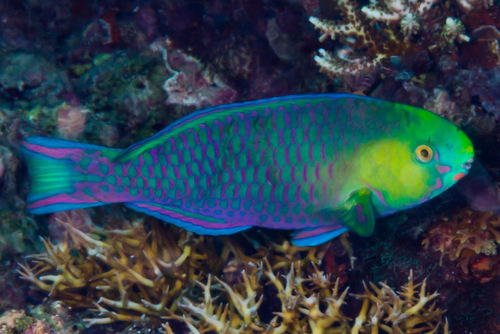
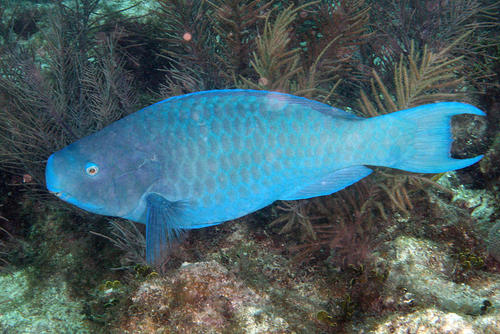
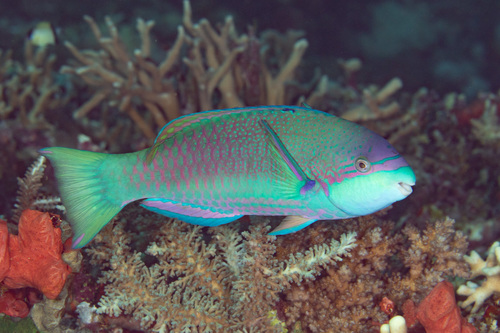
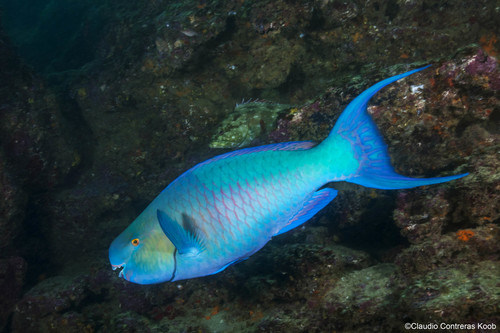
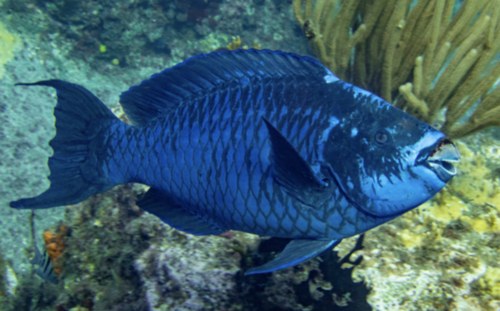
The midnight parrotfish has a deep blue body with light blue patches along its sides and head. While the exact location of these light blue patches varies between individual fish, all midnight parrotfish have a distinct light blue patch on the underside of their beak.
Color Pattern Consistency
Unlike most other parrotfish species, the midnight parrotfish keeps the same coloration through both its juvenile and adult life stages, and both males and females display this shared color pattern.
Parrotfish Beak Etymology
Parrotfishes get their name from the hard beak they use to scrape food off hard substrates.
Closely Related Species
The midnight parrotfish is most closely related to two other large-bodied parrotfish species: S. guacamaia and S. trispinosus.
Primary Habitat and Range
The midnight parrotfish lives on coral reefs, primarily found in the Caribbean, southern Florida, and the southern Gulf of Mexico. It has also been recorded as far north as Maryland and as far south as Brazil.
Reef Zonation Pattern
Among 32 studied Caribbean reef fish species, the midnight parrotfish was the only one that did not show significant zonation across patch reefs and crest reefs.
Population Abundance
It is less abundant than many other parrotfish species, including queen parrotfish (Scarus vetula), striped parrotfish (Scarus iseri), stoplight parrotfish (Sparisoma viride), and redband parrotfish (Sparisoma aurofrenatum), but it still forms an important part of the coral reef trophic web.
Ecological Role
Like other parrotfish, the midnight parrotfish controls algal populations through its feeding, and its grazing activity encourages coral growth.
Depth Range
Midnight parrotfish can be found at depths ranging from 5 to 75 meters.