About Sarcozona praecox (F.Muell.) S.T.Blake
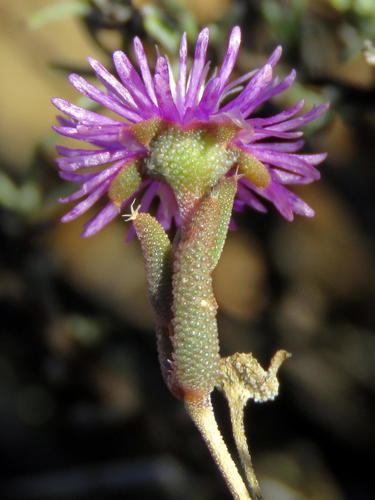
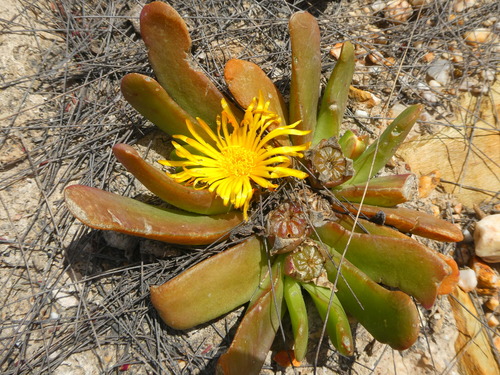
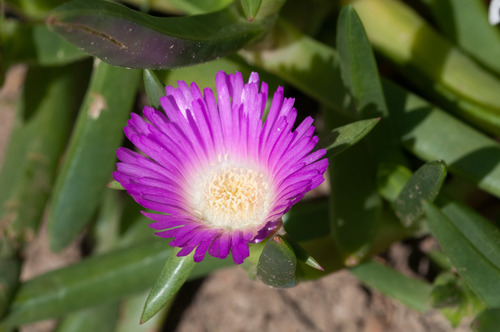
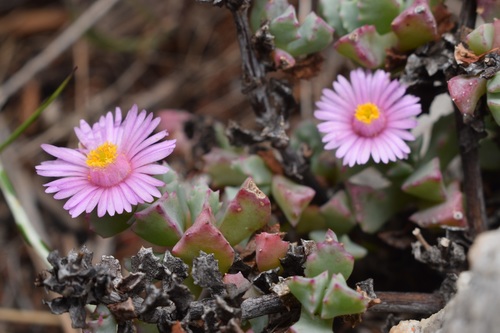
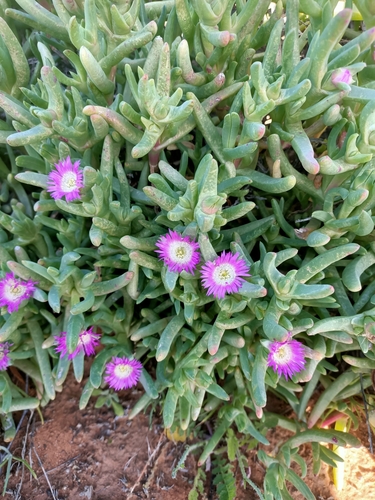
Sarcozona praecox (previously referenced here as Sarcozona bicarinata) is an erect to low-lying, succulent, hairless shrub. It usually grows to a height of 30–50 cm (12–20 in). Its leaves are arranged in opposite pairs, clasp the stem, and measure 40–100 mm (1.6–3.9 in) long and 4–7 mm (0.16–0.28 in) wide. The leaves have a warty texture, are triangular in cross-section, with rounded sides and a flat top. Flowers are borne singly, measure 26–60 mm (1.0–2.4 in) wide, and are either sessile or held on a short stalk. At the base of each flower, two leaves are fused together and partially enclose the flower. The sepal tube is 10–15 mm (0.39–0.59 in) long, and usually has four lobes 3.5–10 mm (0.14–0.39 in) long. Between 20 and 80 pink, petal-like staminodes surround 20 to 150 white stamens and four styles. The ovary is 4.5–9 mm (0.18–0.35 in) long and lacks ribs, which distinguishes it from S. bicarinata. Flowering occurs mainly from August to November, and the fruit is a succulent capsule around 10 mm (0.39 in) in diameter. This Sarcozona species grows near salt lakes, on granite rocks, and occasionally in woodland and mallee in arid areas of western New South Wales, north-western Victoria, south-western Western Australia, southern South Australia and southern Queensland.