About Sapajus flavius (Schreber, 1799)
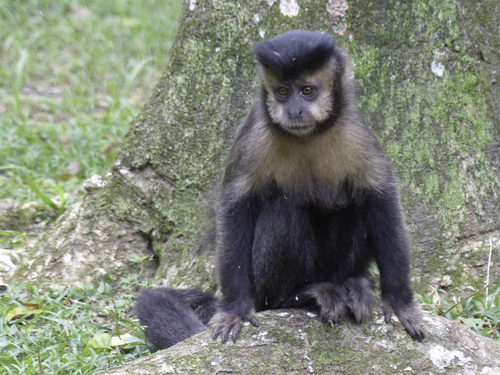
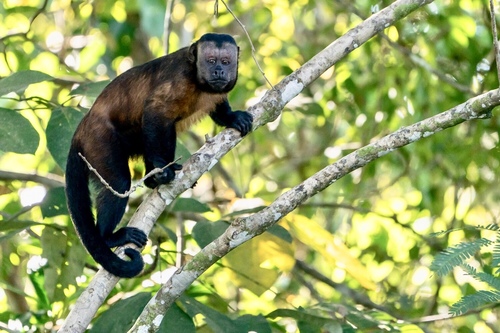
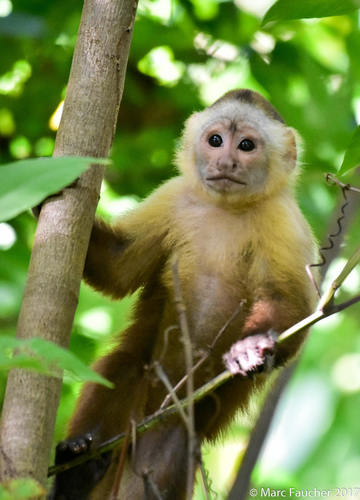
Sapajus flavius, commonly called the blond capuchin, has almost uniformly golden-yellow body hair, with one distinct exception: a whitish cap on the front half of its head. Its face is pink, and it has light-brown eyes.
Throat Flap Features
On the ventral side of its neck, it has a dark, hairless throat flap. The hair covering its hands and feet is much lighter than the hair on the rest of its body, while its palms and the soles of its feet are hairless and black.
Head Hair Traits
Hair on its head grows toward the posterior and is not tufted. The blond capuchin is one of the smaller species of capuchin monkey, reaching a maximum head and body length of 40 cm (16 in).
Body Size and Weight
Like other capuchin species, its tail is almost the same length as its head and body. Adult blond capuchins typically weigh between 2 and 3 kg (4.4 to 6.6 lb).
Atlantic Forest Range
This species lives in the northeastern Atlantic Forest spanning the Brazilian states of Paraíba, Pernambuco, and Alagoas in northeastern Brazil. It was rediscovered in two Atlantic Forest fragments in Paraíba: the Camaratuba Experimental Station and the Engenho Gargaú Private Natural Heritage Reserve.
Population Viability Assessments
Sample individuals from these sites were captured and examined. The population in the Gargaú reserve appeared healthy and is projected to remain viable for the next 100 years, while the Camaratuba population has a 50% risk of extinction.
Additional Range Records
The species has also been sighted at the Pau-Brasil Ecological Station in Paraíba, located just south of the Camaratuba station. The blond capuchin also inhabits the Caatinga biome in the state of Rio Grande do Norte, northeastern Brazil.
Local Ecological Knowledge
Although the species was only officially described in the mid to late 2000s, local residents report having seen it for at least 40 years. Local people also report that blond capuchins frequently raid nearby maize fields.
Caatinga Adaptations
This pattern suggests the species may have been forced to move into and adapt to the Caatinga biome due to human activity. Notably, blond capuchin populations living in the Caatinga spend far more time on the ground than populations that live in the Atlantic Forest.
Termite Fishing Behaviour
Tool use is not common in blond capuchins, but it has been observed in a small number of cases. One observed example is termite fishing by blond capuchins living in Atlantic forests.
Termite Fishing Process
The process follows clear steps: first, the monkeys find an arboreal termite nest, then locate a suitable stick, insert the stick into the nest, pull the stick back out after a short period, and finally eat the termites clinging to the stick.
Millipede Secretion Use
Blond capuchins have also been observed rubbing toxic defensive secretions from Poecilocricus millipedes onto their bodies. All age groups perform this behaviour, which is mostly carried out socially and occurs during mosquito season.
Secretion Use Functions
This suggests the behaviour serves two purposes: as social bonding and as a mosquito repellent. Similar behaviours have been recorded in other capuchin species, where the millipede secretions act as an anti-parasite treatment.
Social Application of Secretions
In blond capuchins, individuals have been observed applying these secretions to hard-to-reach areas on other group members, indicating the social nature of this behaviour may provide additional health and efficacy benefits.
Nut Cracking Behaviour
In the Caatinga biome, blond capuchins have been observed using a 'hammer and anvil' method to crack open Manihot nuts: the hammer is a small rock, and the anvil is a larger rock.