About Salvia spathacea Greene
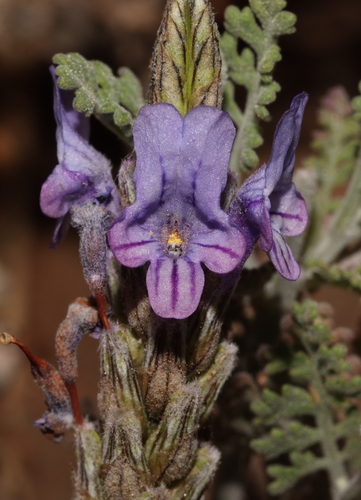
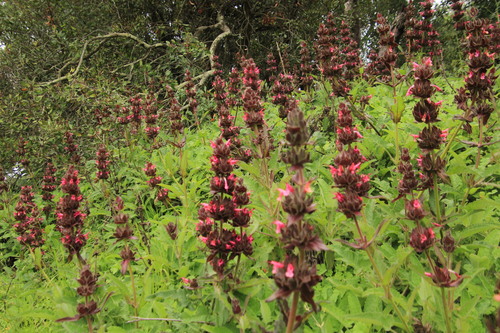
Salvia spathacea Greene is an evergreen perennial that grows flowering stems 30–150 cm (12–59 in) tall from a woody base. When not in flower, plants grow to less than 50 cm (20 in) tall, forming clumps of sprawling foliage. Each individual plant produces a single, rarely branched flowering stem. It spreads via rhizomes and can form colonies up to 130 cm (51 in) in diameter. Like many species in the mint family, it has distinctly pronounced square stems, and the entire plant is covered in wavy glandular hairs. Its bright green leaves are 8–20 cm long, and become highly aromatic when crushed or touched. Leaves range from oblong to nearly arrowhead-shaped at the base, may be puckered and wrinkled, and have rounded teeth along their edges. Like the rest of the plant, leaves are covered in hairs that give the plant a soft texture; hairs are typically denser on the bottom surface of leaves. Flowers grow in clustered, whorled inflorescences that are 15–30 cm (6–12 in) long and 6 cm in diameter, arranged on spike-like stems where flowers form at each node on the upper half of the stem. The inflorescences are subtended by showy bracts that range in color from ruby red to dark maroon or brown. The calyx is 1.5 to 3 cm long, two-lipped, with an entire, unlobed upper lip. Each corolla is tubular and 2.5-3.5 cm long, with two lips. The upper lip of the corolla measures 7–8 mm and has two shallow lobes, while the lower lip is longer at 10–12 mm. Two fertile stamens attach to the corolla tube, and the style is forked. Both the style and stamens protrude out from the corolla tube. Flower colors range from green through light pink and magenta to purple. The fruits are four nutlets, dark brown to black in color, round to ovate in shape, and 3.5 to 6.5 mm long. This species, commonly called pitcher sage, is found in the California Coast Ranges, ranging from the Sacramento Valley south to the San Diego area. It is a common species that grows on open or shady slopes in moist oak woodland, chaparral, and coastal sage scrub, located not far from the Pacific Ocean. Salvia spathacea is easy to grow in gardens, and makes a very useful groundcover for dry shade under oaks. Unlike other California native sages, it spreads from underground rhizomes. It will also grow in open locations in ordinary garden soil, in part shade or even full sun. Supplemental watering can help encourage a longer flowering season, but a late summer period without watering is desirable. As its alternative common name suggests, it is a nectar source for feeding hummingbirds and will attract them to gardens. Deer and gophers generally avoid this strongly aromatic plant. It propagates easily from seeds or rhizomes. Seeds should be collected as early as possible, otherwise they may be predated by insects. S. spathacea can develop powdery mildew, which can be treated with a spray of milk diluted in water. Several cultivars exist, though some selections are more vigorous than others. One showy cultivar is "Confetti", which produces both yellow and pink flowers on the same plant. More robust cultivars include "Powerline Pink", with magenta to crimson flowers, which grows well in hot sun even inland; and "Avis Keedy", which has light yellow flowers. Salvia spathacea has been awarded the Royal Horticultural Society's Award of Garden Merit.