About Salvia oppositiflora Ruiz & Pav.
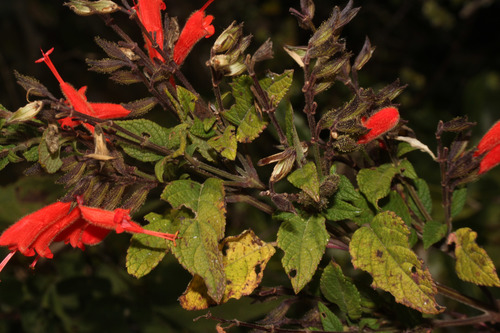
Salvia oppositiflora is a species of perennial flowering plant that belongs to the Lamiaceae family. It is native to Peru, where it grows at high elevations between 7,000 and 12,000 feet. The species was collected in 1798 by Hipólito Ruiz López and José Antonio Pavón Jiménez, and later described in Flora of Peru. At maturity, Salvia oppositiflora reaches 2 to 3 feet in both height and width, and has a floppy growth habit. Its mid-green leaves are ovate and nearly triangular, growing up to 1.5 inches long and 1.5 inches wide. The leaves are either smooth or lightly covered in hairs, and have serrated edges. The flowers of this plant measure 1 inch long, are orange-red in color, and shaped like a tube. Reddish stamens protrude from the flower's lower lip. The inflorescences are short, and the flowers grow in opposite pairs, which is how the plant got its scientific name. Both the lime-green calyces and the stems of the plant are covered with short hairs and glands.