About Salvia azurea Michx. ex Vahl
Nomenclature and Common Name
Salvia azurea Michx. ex Vahl, commonly called blue sage, is a perennial herb.
Mature Stem Height
At full maturity, its stems grow between 0.5 to 1.5 meters, which is equivalent to 1 foot 8 inches to 4 feet 11 inches, in height.
Caudex and Stem Count
Plants grow from a thick caudex, and may produce either one stem or multiple stems.
Leaf Characteristics
Leaves attach to stems via petioles that can grow up to 1.0 cm (0.4 inches) long; leaves are narrow, pointed, with margins ranging from smooth-edged to serrated, and surfaces ranging from furry to smooth.
Basal Leaf Absence
This species does not produce basal leaves.
Flower Color and Size
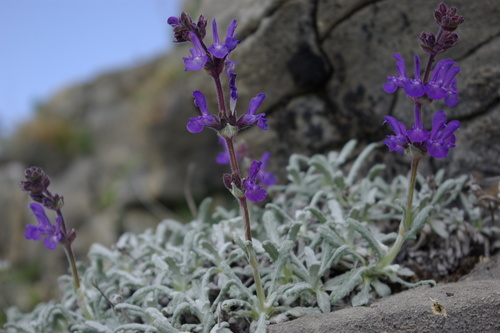
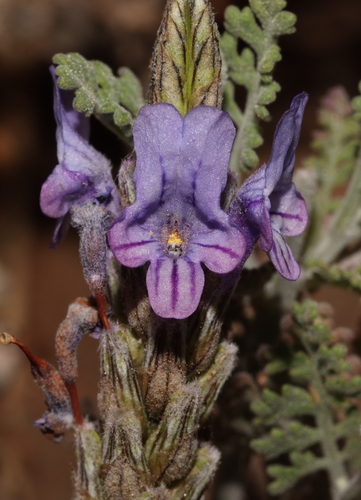
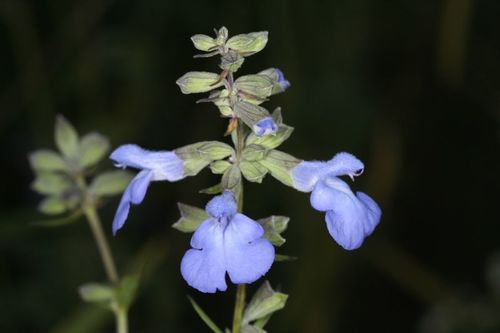
Flowers are blue, rarely white, and measure roughly 6.4 to 12.7 mm (1/4 to 1/2 inch) long.
Flower Bloom Period and Inflorescence
Flowers bloom from summer to autumn, positioned near the tips of either branched or unbranched spikes.
Calyx Characteristics
Their calyxes are tubular or bell-shaped and covered in fuzz.
Recognized Varieties
Two recognized varieties exist: Salvia azurea var. azurea (azure sage) and Salvia azurea var. grandiflora (Pitcher sage).
Wild Stem Growth Habit
In the wild, Salvia azurea typically develops long, unbranched stems that often flop over under the weight of their flowers.
Cultivation Stem Management
When cultivated, stems are sometimes cut back early in the growing season to encourage branching, slow vertical growth, and prevent lodging.
Native Range Dispute
Blue sage is native to the United States, but its natural native range is disputed, with different academic sources reporting different areas where it has been introduced within the US.
Documented US Introductions
Both Plants of the World Online and World Flora Online list the species as introduced in the northeastern US states of New York, Massachusetts, Connecticut, and New Hampshire, as well as the Midwestern state of Wisconsin.
Nebraska and Colorado Distribution
In his book Flora of the Great Plains, botanist Ralph E. Brooks additionally notes the species was introduced to eastern Colorado and western Nebraska, while it is native to the southeastern parts of Nebraska.
Cultivation Escape in India
There are also reports of Salvia azurea escaping cultivation in India.
Southern Great Plains Distribution
It is very common in the southern Great Plains, where it occurs across the eastern three-quarters of Kansas, most of Oklahoma, south Central Missouri, southeastern Nebraska, and east Texas.
Southeastern US Distribution
It is also fairly common in the southeastern US, found in Arkansas, Louisiana, Mississippi, Georgia, South Carolina, and Florida.
Mexican Native Range
World Plants reports that the species is native to the northern Mexican states of Chihuahua and Nuevo León.
Roadside Habitat
Across its entire range, it often grows along roadsides.
Prairie Habitat
It also grows on rocky or sandy prairies, particularly in uplands and pastures.
Southeastern Woodland Habitat
In the southeastern portion of its range, it occurs in rocky or sandy woodlands such as longleaf pine sandhills, and is especially associated with loamy swales and flats within these woodlands.