About Salvia funerea M.E.Jones
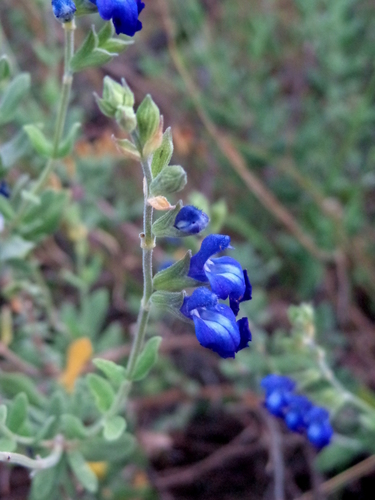
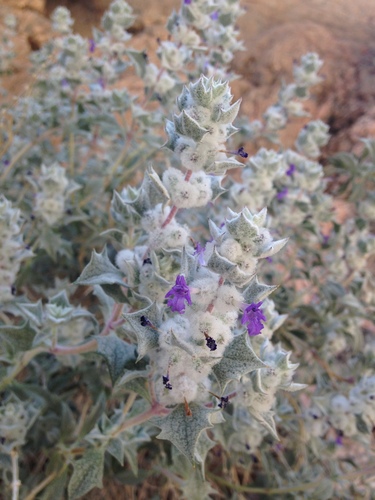
Salvia funerea M.E.Jones is a shrub that can grow over one meter tall. It is densely branched, and all branches are thickly covered in white, woolly hairs. Its leaves measure 9 to 20 mm long, have short petioles, and are typically deciduous. The leaf blade is roughly ovate, tipped with a spine, and sometimes bears spines along its margins. Three flowers generally emerge from the leaf axils of these sharply-toothed leaves. The flowers have a calyx 4.5 to 6 mm wide, with five triangular lobes each tipped with a spine. The violet corolla tube is 12 to 16 mm long, with stamens and style included, meaning they do not extend past the mouth of the corolla. This plant grows in dry alkaline washes with limestone soil, and on limestone cliffs of narrow canyons. It occurs across the western slopes of the Amargosa Range, which includes the Funeral Mountains, Black Mountains, and Granite Mountains; it is also found in Titus Canyon in the Grapevine Mountains, and in Grotto and Mosaic Canyons in the northern Panamint Range. Most of its populations lie within Death Valley National Park, in Inyo County, California and Nye County, Nevada. This species grows alongside Creosote bush scrub (Larrea and Ambrosia), and is commonly found with Atriplex hymenelytra, Bahiopsis reticulata, Encelia farinosa, Encelia actoni, and Eucnide urens. This species is considered unsuitable for cultivation, because it requires the very specific restrictive habitat conditions of limestone cliffs or alkaline desert washes with limestone soil.