About Salvia elegans Vahl
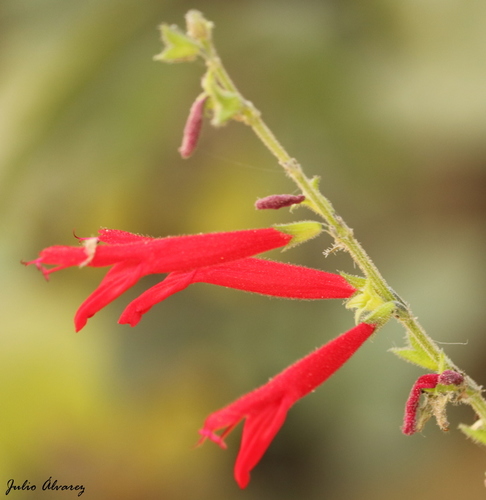
Salvia elegans Vahl, commonly called pineapple sage, is a short-day plant that produces many erect, leafy stems growing up to 150 centimetres (59 in) tall. Its leaves have a distinct pleasant scent similar to pineapple. In its native Mexico, its flowering season starts in August; in areas further north, flowering may not begin until later autumn, and if no frost occurs, it can continue flowering until spring. It produces tubular red flowers. The cultivar 'Honey Melon' has leaves with the same pineapple fragrance, but it blooms in early summer instead of autumn. The variant known as tangerine sage reaches about 60–90 cm (24–35 in) in height, has leaves with bronze edges, carries a citrus scent, and flowers in summer. This species is a shrub native to Mexico, where it grows in Madrean and Mesoamerican pine–oak forests at elevations between 1,800 and 2,700 m (6,000 and 9,000 ft). The plant's red tubular flowers attract a wide range of pollinators including hummingbirds, butterflies, bees, beetles, and flies, with hummingbirds acting as its primary pollinator. In a central Mexican highland temperate forest, pineapple sage was recorded as one of the three plant species most frequently visited by hummingbirds. Its flower structure has a longer upper lip than lower lip, a pollination syndrome shared with other bird-pollinated species that is thought to have evolved over time through selection by its primary pollinators. Pineapple sage shares a close ecological relationship with hummingbirds, due to overlapping elevational distributions and shared ecological constraints. Each plant produces a large number of flowers, making it an abundant food source for hummingbirds, which need large volumes of nectar to meet their energy needs. However, this trait of producing many flowers per plant can promote geitonogamy, a form of fertilization that occurs when hummingbirds visit multiple flowers on the same individual plant. S. elegans exhibits incomplete dichogamy: there is a small temporal overlap between the period when anthers release pollen and when stigmas become receptive to pollen. In this species, anthers develop and release pollen before the plant's own stigmas become receptive. While this reproductive strategy can allow self-pollination and potentially lead to inbreeding depression, it primarily favors outcrossing (allogamy). One study found no evidence of inbreeding depression in this species during pre-germination stages. The pattern of incomplete dichogamy helps guarantee fruit and seed production when growing conditions are poor, or when individual plants are widely spaced apart from each other. The rate of self-pollination is further reduced by the flower's herkogamy, a structural trait where the stigma is positioned above the pollen-carrying anthers. Pineapple sage was introduced to horticulture around 1870. When grown in cultivation, it typically reaches a height of 1.2 to 1.5 m (4 to 5 ft), and its roots spread underground to form a large clump. Cultivated plants have pale yellow-green leaves that are veined and covered in fine hairs. Six to twelve scarlet flowers grow in whorls, arranged along a long inflorescence that blooms gradually and flowers for an extended period. After a hard frost, the above-ground growth of the plant dies back, and it regrows from the root system the following spring. Both the leaves and flowers of S. elegans are edible. The plant is used in Mexican traditional medicine, most commonly to treat anxiety and hypertension.